ԹϺ Unveils Accelerated Roadmap to Achieve Universal, Fully Fault-Tolerant Quantum Computing by 2030
With thousands of physical qubits, hundreds of logical qubits, low error rates, and a fully integrated software stack, ԹϺ’s roadmap outlines its path to achieve scientific advantage and a tipping point for commercial advantage
September 10, 2024
In collaboration with Microsoft, ԹϺ also demonstrates two industry firsts: 12 logical qubits and an end-to-end scientific workflow using AI, High-Performance Computing (HPC), and logical qubits on what Microsoft has previously described as “the path to a Quantum Supercomputer”
Broomfield, Colorado and London, UK, September 10th, 2024 — Today, ԹϺ, the world’s largest and leading integrated quantum computing company, unveiled its roadmap to universal, fully fault-tolerant quantum computing by 2030. The roadmap materially accelerates the path to commercial quantum computing systems with the potential to unlock a trillion-dollar market and enable AI to help solve some of the world’s most pressing problems. In parallel, ԹϺ in partnership with Microsoft announced a series of milestones and integrations.
ԹϺ’s roadmap unveils its fifth-generation quantum computer, Apollo, which will be a fully fault-tolerant and universal quantum computer, capable of executing circuits with millions of gates, delivering scientific advantage and enabling a commercial tipping point.
“We are the only company with a clear and demonstrable path that leverages quantum computing to tackle large-scale scientific and commercial applications,” said Dr. Rajeeb Hazra, CEO of ԹϺ. “With our proven record of driving technological advancement and the unwavering trust of our global customers and partners, we are confident that we possess the industry’s most credible roadmap toward achieving universal fully fault-tolerant quantum computing.”
The roadmap is built on the foundations of ԹϺ’s fully scalable quantum charge-coupled device (QCCD) architecture, including a universal gate set and high-fidelity physical qubits uniquely capable of supporting reliable logical qubits. For four years now, ԹϺ has remained steadfast in providing data along with peer-reviewed papers to show the science and engineering work behind these methodical advances.
“Our next system, ԹϺ Helios, will support enough logical qubits to unlock scientific and mathematics advances that will clearly surpass classical computing,” Hazra said. “Our roadmap then draws a direct line to hundreds of logical qubits, at which point quantum computing will outperform classical computing to address a broad range of scientific problems in areas like finance, chemistry, and computational biology. We also know, from experience, that utility in the form of applications that are suitable for global enterprises and governments will likely bubble to the surface and increase rapidly over the next 18 months. Our quantum computers are already impossible to simulate classically.”
ԹϺ also announced another milestone today in collaboration with Microsoft: achieving 12 logical qubits on the newly updated 56-qubit System Model H2 quantum computer, a 3x advance over the four logical qubits the companies announced in April. Microsoft also used the System Model H1 quantum computer to run the first ever chemistry simulation using reliable logical qubits combined with AI and HPC to produce results within chemical accuracy. Finally, ԹϺ and Microsoft have completed the integration of ԹϺ’s InQuanto™ computational quantum chemistry software package with Azure Quantum Elements, making it available to customers through private preview.
“The collaboration between ԹϺ and Microsoft has established a crucial step forward for the industry and demonstrated a critical milestone on the path to hybrid classical-quantum supercomputing capable of transforming scientific discovery,” said Dr. Krysta Svore – Technical Fellow and VP of Advanced Quantum Development for Microsoft Azure Quantum.
“It is now clear that enterprises need to be ready to take advantage of the progress we can see coming in the next business cycle,” Hazra said. “Our customers are placing quantum in their strategic plans and finding new ways to align our quantum system with classical computing and generative AI.”
In 2019, ԹϺ’s H-Series devices were among the first to be offered commercially via Microsoft Azure. Today, ԹϺ’s H1 and H2 quantum computers, Powered by Honeywell, remain available on Azure and directly to ԹϺ customers and partners.
In the past few years, ԹϺ has achieved many significant milestones, including:
A blog post with more details on the ԹϺ quantum hardware roadmap can be viewed . The Microsoft announcement regarding the 12 logical qubits can viewed .
About ԹϺ
ԹϺ, the world’s largest integrated quantum computing company, pioneers powerful quantum computers and advanced software solutions. ԹϺ’s technology drives breakthroughs in materials discovery, cybersecurity, and next-gen quantum AI. With over 500 employees, including 370+ scientists and engineers, ԹϺ leads the quantum computing revolution across continents.
About ԹϺ
ԹϺ,the world’s largest integrated quantum company, pioneers powerful quantum computers and advanced software solutions. ԹϺ’s technology drives breakthroughs in materials discovery, cybersecurity, and next-gen quantum AI. With over 500 employees, including 370+ scientists and engineers, ԹϺ leads the quantum computing revolution across continents.
April 22, 2026
Honeywell Announces ԹϺ’s Confidential Submission of Draft Registration Statement for Proposed Initial Public Offering
Source:
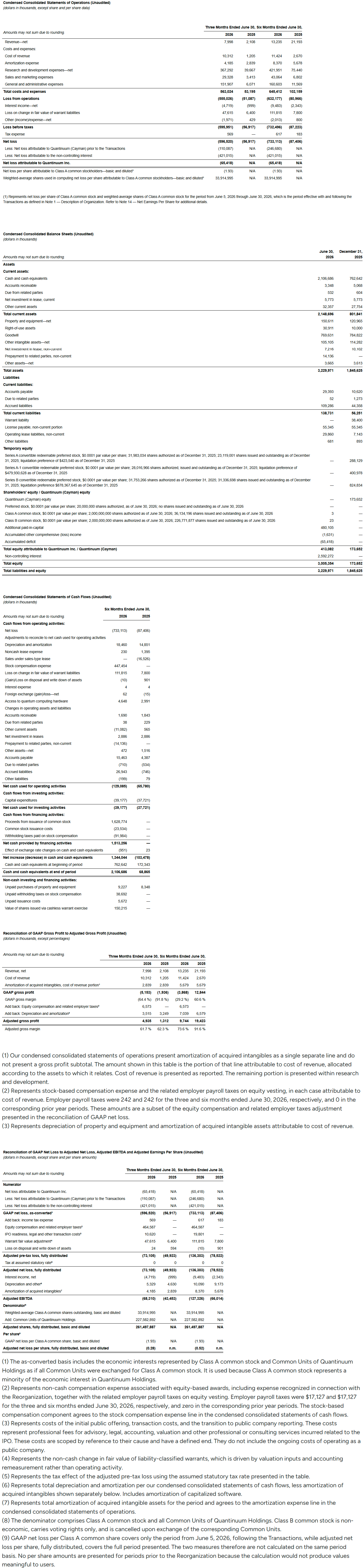
Charlotte, N.C., April 22, 2026 — Honeywell (NASDAQ: ) today announced that ԹϺ LLC (“ԹϺ” or the “Company”), which is majority owned by Honeywell, confidentially submitted a draft registration statement on Form S-1 to the U.S. Securities and Exchange Commission (the “SEC”) on February 17, 2026, relating to the proposed initial public offering of ԹϺ’s common stock. The number of shares to be offered and the price range for the proposed offering have not yet been determined. The offering is subject to market and other conditions and the completion of the SEC’s review process.
This press release is being made pursuant to, and in accordance with, Rule 135 under the Securities Act of 1933, as amended (the “Securities Act”), and shall not constitute an offer to sell, or the solicitation of an offer to buy, any securities. Any offers, solicitations or offers to buy, or any sales of securities, will be made in accordance with the registration requirements of the Securities Act.
RIKEN Scales Quantum-Supercomputing in Japan with ԹϺ System Upgrade
TOKYO — April 14, 2026 — ԹϺ, a leading quantum computing company, today announced that RIKEN, Japan’s premier national research institute, has procured its System Model H2 quantum computer to scale the capability of “Reimei-Fugaku,” a hybrid quantum-supercomputer platform in Japan.
The Reimei-Fugaku platform represents the frontier of computing technology. Launched in the spring of 2025, it combines ԹϺ’s "Reimei" quantum system with RIKEN’s "Fugaku," one of the world’s fastest supercomputers—more formally known as a high-performance computing (HPC) system.
Now, the hybrid compute platform is getting a substantial upgrade. Earlier this month, ԹϺ delivered its H2 system to RIKEN’s research facility near Tokyo, where assembly is already underway to replace its predecessor, System Model H1, which Reimei has been based on to date. The newer-generation, 56-qubit system is engineered for high-fidelity operations that can reduce time-to-solution, enable larger workloads, and support higher-value applications.
Technology leaders see hybrid compute systems as a practical way to overcome the limits of classical HPC. By combining the significant data-processing power of HPC with a quantum computer’s ability to model complex molecules and materials, researchers could be enabled to solve specialized mathematical problems that are impractical for classical systems to handle alone.
Researchers have already demonstrated this potential using the current Reimei-Fugaku platform. In a workflow with relevance potentially extending to future pharmaceutical applications, they successfully simulated biomolecular reactions at an accuracy that would be infeasible for HPC to achieve in isolation.
With multiple studies in chemistry and materials science already underway on the platform, this H2 upgrade is expected to accelerate research and unlock even more complex scientific discoveries across disciplines.
Dr. Mitsuhisa Sato, Division Director of the Quantum-HPC Hybrid Platform Division, RIKEN Center for Computational Science, said: “Since its installation in February 2025, Reimei H1 has been widely used by users and has delivered significant results, thanks to its high fidelity and flexible qubit connectivity. The upgrade to H2 is exactly what we have been eagerly anticipating, and with its 56 qubits, we expect it to play a key role in demonstrating quantum advantage through quantum–HPC hybrid computing.”
Dr. Rajeeb Hazra, President and CEO of ԹϺ, said: “We believe RIKEN’s decision to continue adopting ԹϺ systems to meet its ambitious objectives is a validation of our technology roadmap and a reflection of the success of our valued partnership. With ԹϺ and RIKEN’s combined leadership in quantum and HPC, respectively, we expect to continue pushing the boundaries of computing to address some of the most critical and complex challenges facing science and industry today.”
This development reflects the continued progress of ԹϺ and RIKEN’s collaboration to advance quantum-HPC hybrid infrastructure in Japan. ԹϺ intends to continue working with the country’s research community to accelerate real-world use cases and contribute to the growth of its quantum ecosystem.
About RIKEN
RIKEN, a National Research and Development Agency, is Japan’s leading national comprehensive research institution renowned for high-quality research in a diverse range of scientific disciplines. Founded in 1917, initially as a private research foundation, RIKEN has grown rapidly in size and scope, today encompassing a network of world-class research centers and institutes across Japan.
About ԹϺ
ԹϺ is a leading quantum computing company offering a full-stack platform designed to make quantum computing deployable in real-world environments. The company has commercially deployed multiple generations of quantum systems built on the well-established QCCD architecture, which it has implemented with novel designs and capabilities to achieve the industry’s highest accuracy levels based on average two-qubit gate fidelity. ԹϺ has active engagements with market leaders across pharmaceuticals, material science, financial services, and government and industrial markets.
The company has a global workforce of approximately 700 employees, including top scientists and researchers. Over 70% of its technology team hold PhDs. ԹϺ’s headquarters is in Broomfield, Colorado, with additional facilities across the United States, United Kingdom, Germany, Japan, and Singapore.
March 18, 2026 – BROOMFIELD, Colo. – ԹϺ, a leading quantum computing company, today announced the appointment of Nitesh Sharan as Chief Financial Officer (CFO), effective April 6, 2026.
Mr. Sharan brings more than 25 years of global finance experience across technology, consumer products and consulting. He joins the company after nearly five years as CFO of SoundHound AI, Inc., where he led the company through its public listing in 2022 and oversaw strategic financial planning, accounting, corporate strategy, human resources, legal and intellectual property.
“Nitesh brings an exceptional combination of financial leadership, operational rigor and experience scaling technology companies,” said Dr. Rajeeb Hazra, President & CEO of ԹϺ. “As ԹϺ accelerates the commercialization of quantum computing, his experience guiding companies through complex growth and capital market environments will be pivotal.”
Prior to joining SoundHound AI, Mr. Sharan spent more than 5 years at Nike, where he held several leadership roles, including Vice President of Investor Relations & Treasurer, Vice President of Corporate Finance & Treasurer, and CFO of Global Operations & Technology. Prior to joining Nike, he spent 15 years in senior leadership roles at Hewlett-Packard and began his career as a consultant at Accenture.
Mr. Sharan is a Chartered Financial Analyst (CFA) charterholder. He earned his MBA from Northwestern University’s Kellogg School of Management and his bachelor’s degree from Case Western Reserve University. Originally from Cleveland, Ohio, he currently resides in Portland, Oregon. He serves on a number of boards, including Activate, an organization that supports deep science entrepreneurs in commercializing their innovations, and as a Trustee of the Catlin Gabel School, a progressive K-12 independent school.
About ԹϺ
ԹϺ is a leading quantum computing company offering a full-stack platform designed to make quantum computing deployable in real-world environments. The company has commercially deployed multiple generations of quantum systems built on the well-established QCCD architecture, which it has implemented with novel designs and capabilities to achieve the industry’s highest accuracy levels based on average two-qubit gate fidelity1. ԹϺ has active engagements with market leaders across pharmaceuticals, material science, financial services, and government and industrial markets.
The company has a global workforce of approximately 700 employees, including top scientists and researchers. Over 70% of its technology team hold PhDs. ԹϺ’s headquarters is in Broomfield, Colorado, with additional facilities across the United States, United Kingdom, Germany, Japan, and Singapore.