

Build for the fault-tolerant era with ³Ô¹ÏºÚÁÏÍø Nexus
�
Fault-tolerant quantum computing is entering a new phase. At ³Ô¹ÏºÚÁÏÍø, we have demonstrated almost every piece needed for large-scale fault tolerant hardware, from a , to a proven fault tolerant architecture, to , at world-leading fidelity.
However, that’s only half the battle. Developers need practical tools that make this technology accessible without needing to become experts in quantum error correction.
A good quantum computing software stack should capture and reuse QEC1 expertise, turning the complexity of fault tolerance into capabilities that developers can build with.
"Our ambition is for Nexus to be the platform developers turn to for the fault-tolerant era." - Dr. Rajeeb Hazra, President & CEO, ³Ô¹ÏºÚÁÏÍø
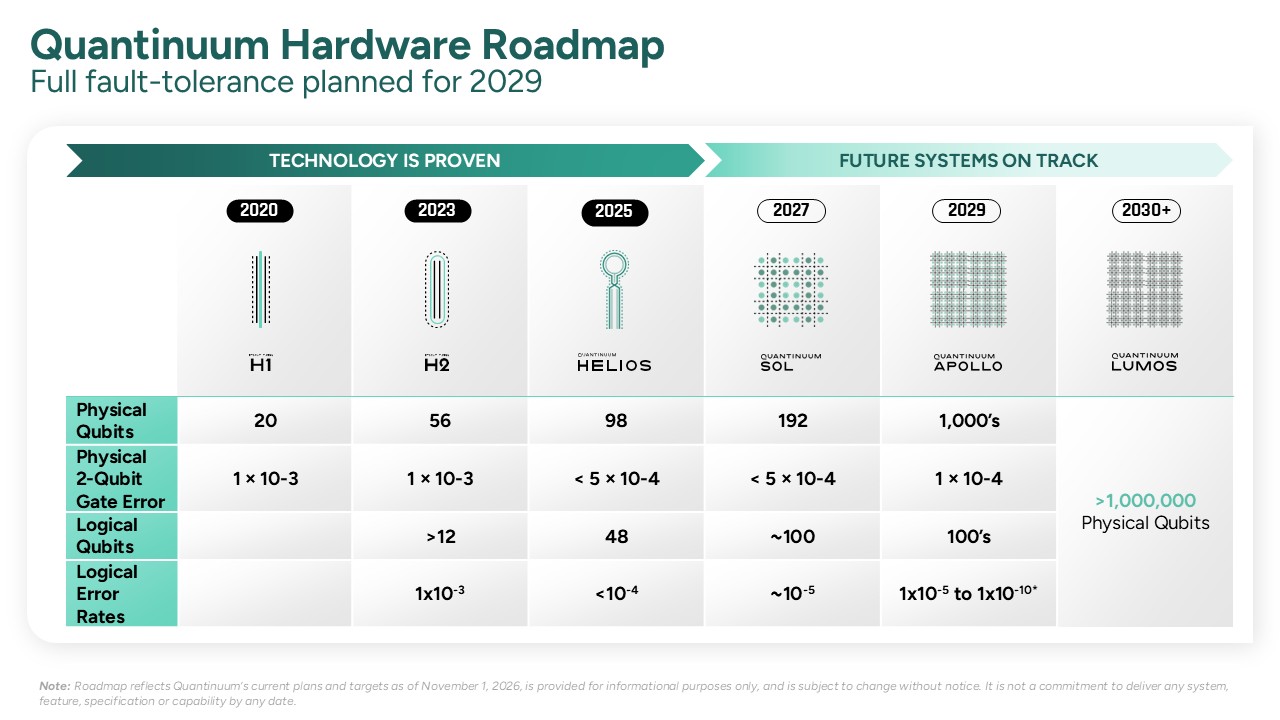
Here at ³Ô¹ÏºÚÁÏÍø, we are working hard to make that a reality. Since its launch in 2024, Nexus has grown from managing cloud-based quantum workflows into an environment for end-to-end application development and deployment. Our new multi-year roadmap builds on that foundation, connecting software capabilities with each generation of ³Ô¹ÏºÚÁÏÍø hardware through Apollo, our universal, fault-tolerant quantum computer planned for 2029. Nexus will progressively handle more of the complexity of fault-tolerant development, helping developers build applications that grow in capability as the hardware advances.
With Nexus, you can explore quantum chemistry and materials using InQuanto, and you can make it fault tolerant using our pre-built fault tolerant primitives. You can use GPUs to decode errors in real time, while benefitting from hardware enabled error suppression like or . You can also connect your HPC to our QPUs and use Nexus’ Hybrid workflow management system to enjoy the best of both worlds seamlessly.
Of course, all of the above needs a language framework that is fault tolerant in the first place. That’s why we are thrilled to introduce – Nexus’ fault tolerant quantum programming framework, and , Nexus’ library of reusable algorithmic primitives.
Developing for the fault tolerant era: Guppy FT
“The field of QEC is quite abstract, and it is hard for non-experts to gauge what is feasible on current devices. Guppy FT promotes a game-changing paradigm: QEC is no longer just theory, it is also engineering, it is something you can use.� - the Guppy FT team
As we have been saying, the NISQ2 era is coming to an end. The next challenge is to turn fault tolerance from a hardware milestone into a capability developers can use. �
We have built the physical QEC architecture: , , , , , , and so on. The next step is ensuring our users can easily enjoy the above: with a fault tolerant programming language framework (Guppy FT) inside a fault tolerant user platform (Nexus).
Guppy FT brings three complementary capabilities together:
- A framework for QEC experts to define fault-tolerant architectures.
- Automatic compilation that takes programs written in standard Guppy and turns them into programs running on fault-tolerant architectures.
- Proprietary codes from our own QEC experts that get you the best performance out of our world-leading hardware.
The result is a programming experience in which developers can write quantum algorithms without having to understand the details of the underlying error-correction architecture, while QEC experts retain the ability to define and optimize the architectures that power those programs.
This separation between what the program does and how it is made fault tolerant is central to the approach.
With Guppy FT, QEC experts define the fault-tolerant architecture once, and application developers can program on it without needing to become QEC experts themselves. Developers can continue to write programs in standard, QEC-agnostic Guppy. The Guppy FT framework then automatically lowers those programs into an encoded, fault-tolerant form suitable for execution.
�
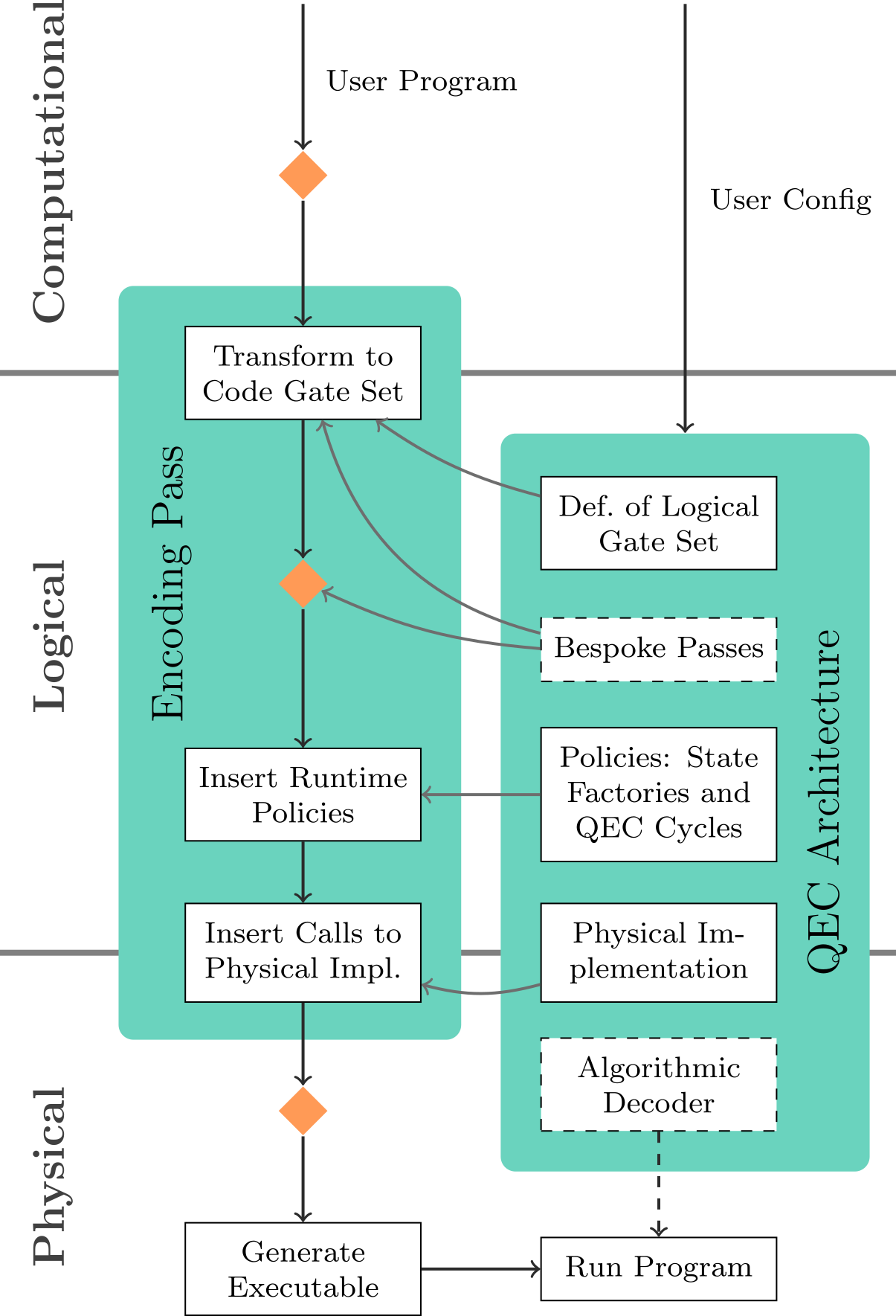
As fault-tolerant techniques improve, the same high-level programming model can therefore serve as a stable interface between applications and increasingly sophisticated QEC implementations. This approach also makes it possible to evolve the underlying architecture without requiring every application developer to rewrite their programs around its implementation details – a crucial benefit as we stay at the forefront of a quickly evolving field.
Available to users today, Guppy FT is an important step toward software designed for the fault-tolerant era. You can use already-perfected codes, like our , through Nexus, with more codes coming online as they are developed.
Optimize your work with Guppy Algorithms & Realtime Analytics
We want you doing more than just writing fault tolerant programs – we want to help you write quickly and optimally.
With Guppy Algorithms, you can save needless repetition of work by constructing complex application-level software workflows in an application-agnostic way. Built on Guppy, Guppy Algorithms combines type-safe Guppy primitives with Python builders to help developers construct quantum algorithms out of already optimized building blocks. Guppy Algorithms is also QEC agnostic, enabling users to evolve their fault tolerance approach as the platform grows, without needing to re-write finished programs.
Current highlights include primitives that help you with:
- Trotterisation for Hamiltonian Simulation
- Quantum linear algebra
- Quantum arithmetic
Using Guppy Algorithms is simple. First, you build your abstract (application-specific) algorithm. Then, you simply compose it with Guppy Algorithms: import your desired implementations of circuit sub-components and bring your workflow to life.
"Guppy FT and Guppy Algorithms add a necessary abstraction on top of Guppy’s flexible programming model, so that application development and QEC research can advance in lockstep without either having to bake in assumptions about the other.� - Seyon Sivarajah, Chief Architect of Developer Tools
Soon, we plan to expand Guppy Algorithms to include end-to-end workflows of reusable components.
Of course, a set of optimized building blocks isn’t enough to ensure every program you write is optimal for execution. To that end, Nexus is introducing two tools to help users understand and optimize hardware execution:
- �Real-time metrics that provide execution statistics, including gate counts and shot duration.
- ShotPlot, our tool for visualizing gate scheduling, helping users identify idle periods and improve circuit layout.
With these functionalities, you can try new approaches to minimizing gate counts or runtime with real-time feedback that helps you further optimize your result. Taken together, these new tools ensure that Nexus provides an optimal programming experience, from the circuit level to the user experience.
Using Guppy FT to reduce errors on quantum hardware: an end-to-end demonstration on Helios
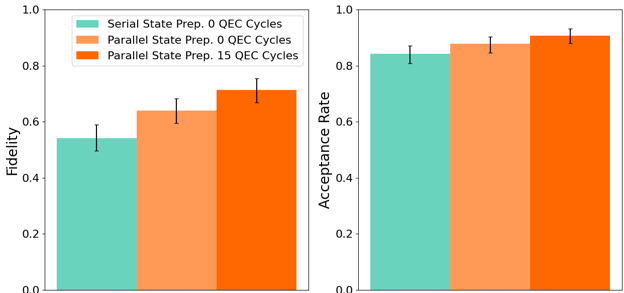
To demonstrate Guppy FT, the team ran a Steane-encoded quantum algorithm, HHL, on ³Ô¹ÏºÚÁÏÍø’s Helios quantum computer.
The team compared three versions of the HHL program, with different settings for Guppy FT’s Steane code ([[7, 1, 3]]) encoding, each with 500 shots. The first used no explicit QEC cycles and performed on-demand, sequential state preparation. The second used Guppy FT’s state factories to parallelize state preparation, and the third also applied three QEC cycles to each of the five qubits.
Each shot is comprised of three stages: the HHL program, mid-circuit error detection, and the inverse of the HHL program. Mid-circuit error detection measures the ancilla qubits used by the HHL program, which it ought to disentangle from the data qubits. If an error is detected, the shot is discarded; otherwise, it moves on to the final stage and is marked as accepted. Fidelity is computed as the proportion of accepted shots that the inverse HHL program successfully returns to the initial state.
The results show that both QEC cycles and parallelized state preparation improve performance. Â QEC cycles actively correct errors while parallelization shortens execution time, reducing the chance of errors. Together, these results demonstrate how Guppy FT can implement fault-tolerant architectures for practical, end-to-end programs running on real quantum hardware.
Deploy Your Hybrid Quantum-Classical Application
The future of quantum computing is more than fault tolerant: it’s hybrid. Close co-ordination between classical and quantum computing resources will be essential for most killer use-cases, with a combination of AI, HPC, and QPU each working on the sub-components they are best suited for.
We’ve been perfecting hybridization for years now, including hybridizing our QPUs with the Fugaku supercomputer at RIKEN. Along the way, we have developed a robust event-based hybrid compute runtime, now available through Nexus. Our updated hybrid compute framework features:
- Multiple storage implementations
- Workflow attempts and restart improvements
- Runtime configuration files
- OTEL tracing and observability
- Workflow cancellation
- SQLite based state management
³Ô¹ÏºÚÁÏÍø Nexus: A foundation for what comes next
Nexus brings together the capabilities and infrastructure needed to develop, analyze, run, and manage hybrid quantum-classical programs across the stack. By unifying quantum programming, validation, fault tolerance, compilation, and execution in one place, with interoperability across third-party environments, Nexus is making fault tolerance a practical reality.
Nexus users are already using our quantum processors to explore applications in , , , , , and more. As our Nexus roadmap evolves, we plan on deploying ecosystem tools and libraries, as well as an applications marketplace where developers can monetize their work.

“Quantum computers are on the brink of achieving fault tolerance at scale. It's exciting: we are entering terra incognita for what we can compute. The new challenge is putting our high-level quantum algorithms into the right form to successfully run on error-corrected hardware. Developer platforms like Nexus help us bridge that gap between quantum algorithm design and deployment
�
-José Ignacio Latorre, Director, Centre for Quantum Technologies at the National University of Singapore at the National University of Singapore
By bringing everything together, Nexus is becoming a robust platform in which fault tolerance is a feature, rather than a barrier to entry.
Get ready for the fault tolerant future.
1 Quantum Error Correction
2 Noisy Intermediate Scale Quantum
About ³Ô¹ÏºÚÁÏÍø
³Ô¹ÏºÚÁÏÍø, the world’s largest integrated quantum company, pioneers powerful quantum computers and advanced software solutions. ³Ô¹ÏºÚÁÏÍø’s technology drives breakthroughs in materials discovery, cybersecurity, and next-gen quantum AI. With over 500 employees, including 370+ scientists and engineers, ³Ô¹ÏºÚÁÏÍø leads the quantum computing revolution across continents.Â
Organizations are increasingly building quantum capabilities to tackle real-world challenges, from evaluating vast numbers of possible outcomes to running simulations that push the limits of classical computing.
At the Singapore Week of Innovation and Technology (SWITCH) 2026, discussions centered on how businesses can explore potential quantum applications and build the capabilities needed for adoption. Organized by Enterprise Singapore, SWITCH brought together industry players and technology partners to exchange insights on quantum and other emerging innovations. ³Ô¹ÏºÚÁÏÍø had the opportunity to contribute to these discussions through workshops.
Emily Liew, Assistant Managing Director, Innovation at Enterprise Singapore, highlighted the importance of such industry engagements:
“As quantum computing continues to advance, Enterprise Singapore is helping companies explore how the technology could be applied to real-world business challenges. This includes identifying relevant problem statements and working with quantum technology partners to build capabilities. Industry engagements, including workshops by ³Ô¹ÏºÚÁÏÍø at SWITCH, provide opportunities for companies to engage with quantum experts, explore potential applications and take practical steps towards adopting the technology as it matures.â€�
We heard a consistent theme across discussions at SWITCH. Building quantum readiness should start now. Developing the expertise, partnerships, and processes needed to capture quantum advantage may take time, but getting started does not require significant upfront investment. Waiting, however, carries risk. By the time quantum computing reaches broader adoption, early movers may already have developed the capabilities needed to seize a competitive edge.
Here are four lessons for leaders exploring quantum adoption today.
Lesson #1: Early experience builds engagement and lays the groundwork
HSBC, the financial services giant, has for many years explored quantum applications in financial modeling, optimization, and machine learning while building the internal expertise to evaluate them. Its work includes hybrid quantum-classical approaches to forecasting and pattern detection, helping teams assess where quantum methods may offer advantages as the technology evolves.
Georgios Korpas, SVP, Quantum & Advanced Compute at HSBC, brought the perspective of an organization that has built this expertise over time, including through a dedicated quantum center. (Other organizations don’t need a dedicated center to benefit from early, practical experience.)
As Georgios put it:
“At HSBC, we have invested in building quantum expertise and exploring the technology against relevant problems in financial services. That work has helped us develop the knowledge, internal capability, and practical experience needed to assess where quantum technologies can add value as the technology develops.�
HSBC’s experience highlights the importance of sustained engagement. Identifying relevant problems, establishing classical benchmarks, developing expertise, and building partnerships all take time. Each project can sharpen an organization’s understanding of what quantum methods can do, where they fall short, and which opportunities warrant further investigation.
That work can begin well before quantum computing reaches full commercial maturity. Organizations gaining experience today are building the knowledge and relationships to make better-informed decisions. We believe they will be poised to move quickly when promising applications become viable.
Lesson #2: Quantum is expected to augment, not replace, your existing technology stack
Multiple speakers emphasized quantum’s role within hybrid workflows, where quantum processors perform specific computations alongside classical high-performance computing and AI.
Researchers from Singapore Management University illustrated this approach with a workflow designed to stress test Singapore’s semiconductor supply chain. The team, led by Hoong Chuin Lau and Monit Sharma, modeled how disruptions such as port congestion, shipping delays, and geopolitical events can compound across global networks, experimenting with ³Ô¹ÏºÚÁÏÍø systems to explore and sample complex disruption scenarios.
The division of work was practical: quantum hardware proposed new combinations of disruptions, while classical optimization tools calculated their operational and financial impact and evaluated potential mitigation strategies. The aim was to help organizations identify vulnerabilities and test responses within a broader supply-chain resilience workflow.
Adrian Mak, Principal Scientist at A*STAR IAIC, who leads a team of quantum chemists, described a similar approach to scientific computing:
“The opportunity is not about quantum replacing classical computing. It is about understanding where quantum methods can complement existing computational approaches, particularly on problems that become difficult at scale. Developing the algorithms, workflows, and expertise alongside advances in hardware is an important part of turning quantum computing into a useful scientific capability.�
A paradigm shift isn’t necessary for extracting value. The practical question is where a quantum computation could improve a specific step in an existing workflow. Answering it requires evaluating computation and its contribution to the overall result. The SMU example makes this tangible: quantum methods explored disruption scenarios, while classical tools translated those scenarios into consequences that decision makers could assess.
Lesson #3: Evaluate platforms by outcomes, not headline metrics
For organizations exploring quantum, understanding progress means looking beyond headline qubit counts. The ability to perform reliable computations depends on how the whole system works together, including how effectively it detects and corrects errors.
³Ô¹ÏºÚÁÏÍø’s Senior R&D Scientist Dr. Natansh Mathur explored this point during a panel at SWITCH on quantum error correction and the path to fault-tolerant quantum computing. He described ³Ô¹ÏºÚÁÏÍø’s recent error correction results: as the code size increased, logical errors fell significantly, which we view as a key steppingstone toward fault tolerance. He also identified what we anticipate will be the next milestone—performing the decoding needed for error correction in real time.
The panel’s broader message was that no single metric can capture progress toward full fault tolerance. Making one number the target risks diverting attention from the scientific and engineering advances needed to deliver a useful system.
Progress also depends on developing applications alongside the hardware. Sergi Ramos-Calderer, Research Fellow at the Centre for Quantum Technologies in Singapore, emphasized the connection. He said, “Quantum computers and their applications must be built alongside each other. Those at the hardware frontier will reach quantum advantage first.�
For leaders, these insights offer a practical way to assess technology roadmaps and potential partners. Ask how improvements in hardware, error correction, and application development work together. Ask what those improvements could enable for the problems your organization wants to solve.
Lesson #4: Keep early steps focused
Getting started with quantum doesn’t have to mean justifying major capital investments, hiring dedicated teams, or launching multiyear transformation programs. A first engagement can be focused on one important computational problem and a clear plan for evaluating it.
³Ô¹ÏºÚÁÏÍø’s Marvin Lee, who leads our work in Singapore, shared on stage that “enterprises don’t need to begin with a large quantum program.â€� He encouraged organizations to bring their own specialists together with quantum experts around one important computational problem, establishing what can be done today and what still needs to improve. This approach, he explained, “creates a practical pathway to help organizations build capability as the technology advances.â€�
³Ô¹ÏºÚÁÏÍø’s collaboration with GE Vernova shows what’s possible. Our teams are combining GE Vernova’s materials science and engineering expertise with our quantum computing capabilities to investigate high-temperature superconductivity. Through this work, GE Vernova is expanding its quantum research into a new area and building its internal quantum talent.
The same principle applies to your organization. Start with a problem your team knows well. Document how it is solved currently, where existing methods fall short, and what an improvement would be worth. Then work with quantum specialists to assess whether quantum methods warrant exploration and what a useful test would look like.
Where there is a credible opportunity, a focused exploratory project can test quantum methods against rigorous classical benchmarks. The aim is to produce evidence that informs the next decision: whether to continue, refine the approach, or revisit it as the technology develops.
Build capability today. Capture value tomorrow.
Together, these lessons point to a practical starting place. Choose a meaningful problem, explore where quantum could complement existing tools, assess progress across the whole system, and keep the initial scope manageable. Organizations do not need to predict exactly when quantum will deliver a commercial advantage to begin preparing. They can start building the expertise and evidence needed to recognize and act on the opportunity.
Forward-Looking Statements
This blog post contains forward-looking statements within the meaning of the Private Securities Litigation Reform Act of 1995, including statements about the development, capabilities, performance, and adoption of quantum computing technologies; ³Ô¹ÏºÚÁÏÍø’s technology roadmap, including progress toward fault-tolerant quantum computing and real-time error correction decoding; the potential applications, benefits, and timing of quantum advantage; and ³Ô¹ÏºÚÁÏÍø’s collaborations with customers, partners, and research institutions. Words such as “will,â€� “may,â€� “could,â€� “expect,â€� “aim,â€� “potential,â€� “milestone,â€� “path,â€� and similar expressions are intended to identify forward-looking statements. These statements are based on current expectations and assumptions and are subject to risks and uncertainties that could cause actual results to differ materially, including risks relating to the pace of scientific and technological development, our ability to achieve technical milestones on anticipated timelines or at all, competition, the rate of market adoption of quantum computing, our reliance on collaborations and key customers, and the other risks described under “Risk Factorsâ€� in ³Ô¹ÏºÚÁÏÍø’s most recent Quarterly Report on Form 10-Q and other filings with the Securities and Exchange Commission. Forward-looking statements speak only as of the date they are made, and ³Ô¹ÏºÚÁÏÍø undertakes no obligation to update them, except as required by law.
Statements attributed to third parties reflect the views of those individuals or organizations and do not necessarily reflect the views of ³Ô¹ÏºÚÁÏÍø. All third-party names and trademarks are the property of their respective owners, and their use does not imply endorsement.
The next era of computing will be shaped by bringing different computing resources together, and quantum has earned a place in that conversation. At SC26 in Chicago, ³Ô¹ÏºÚÁÏÍø is showing how we’re bringing that hybrid integration to life today.
Consider a researcher studying a molecule. Classical computers prepare the problem, a quantum computer contributes a calculation, and classical computers analyze the results. Those steps may run on different machines, in different locations. Connecting them into a coordinated workflow is essential to making the application useful.
³Ô¹ÏºÚÁÏÍø Nexus is our developer platform that helps manage those connections. It brings quantum programming, testing and execution into one environment and provides the foundation to coordinate quantum calculations with the surrounding classical work. Researchers can focus on the scientific problem without writing custom software to manage every handoff between systems.
Making these connections easier helps more people build quantum applications, including those whose expertise lies in the scientific and industrial problems they want to solve.
Connecting quantum programs to the wider computing environment
A researcher studying a molecule or material needs more than access to a quantum processor. A hybrid application can involve classical preparation, HPC simulation, quantum execution and post-processing. Each stage needs particular resources and may depend on results from an earlier calculation.
As the application grows, coordinating those steps becomes a development challenge. Developers need to specify which tasks can run independently, which must wait for results, and where each task should execute. The resources also operate on different timescales. A quantum job may be waiting in a queue or running remotely. During that time, valuable HPC resources should remain available for other work.
Nexus’ Hybrid Workflow Runtime helps address this challenge. Developers express how the quantum and classical tasks depend on one another, and the runtime coordinates their execution across the relevant resources. Its asynchronous approach allows work to progress without requiring every resource to remain active or blocked while another task completes. This connects quantum job submission to the surrounding classical application, reducing the need for developers to write bespoke logic.
Hybrid workflows in practice: Chemistry with RIKEN
Our work with RIKEN illustrates the scientific workflows this coordination can support.
Calculating how electrons behave in a molecule is central to understanding its properties. These electronic-structure calculations help researchers investigate questions relevant to chemistry and materials science, but they can become increasingly demanding as the problem grows.
RIKEN’s quantum residual exploration method combines quantum and classical contributions to that calculation. Quantum measurements suggest additional electronic configurations—possible arrangements of electrons—which classical routines assess and select for the final calculation.
In a demonstration involving a stretched 12-atom hydrogen chain, the quantum-generated proposals lowered the calculated energy compared with classical-only selection using the same final number of configurations. This improved the energy estimate within that specific comparison.
Our developer tools and platform connected the stages of the application. Guppy expressed the quantum logic, Hybrid Workflow Runtime () coordinated the quantum and classical tasks, and Nexus provided the submission interface for quantum execution. Researchers could develop the application without manually coordinating every handoff.
Working with the infrastructure computing centers already use
As hybrid applications develop, their workflows need to adapt to different resources, tools and operating practices.
That makes interoperability a design requirement for Nexus. Developers should be able to choose resources suited to their application. Computing centers need flexibility to build on existing investments and evolve their infrastructure over time.
HPC scheduling is one example. ³Ô¹ÏºÚÁÏÍø supports connections to workload managers including Slurm, PBS, and PJSub, enabling developers to build around the scheduling infrastructure at their computing center.
With Slurm, Hybrid Workflow Runtime can submit classical tasks to a Slurm-managed environment while quantum jobs are submitted through Nexus. The runtime coordinates the task dependencies, while Slurm allocates the compute resources those tasks need, across both HPC and now QPUs as well given the recent expansion to Slurm announced by NVIDIA to include quantum resources.
Interoperability extends beyond scheduling. A computing center may combine workflow tools, resource-management software and quantum hardware from several providers. Defined interfaces help those components work together as the environment changes.
One example is the Open Quantum-HPC Software Ecosystem, or OpenQSE, a community effort led by Oak Ridge National Laboratory. Its reference architecture defines boundaries across the hybrid computing stack to help different implementations work together. Within that architecture, Nexus' Hybrid Workflow Runtime sits at the application workflow layer, above scheduling and resource-access software. Interfaces such as QRMI and QDMI provide connections toward quantum systems.
Our SC26 demonstration in Chicago illustrates this division of responsibilities. Hybrid Workflow Runtime orchestrates the application, assigning classical chemistry tasks to a shared Slurm executor with an explicit resource profile. The runtime coordinates task dependencies, while Slurm handles placement and hybrid compute resource allocation. The workflow can then interact with QFw to reach quantum execution targets.
Explore the SC26 demonstration .
Building toward fault-tolerant hybrid applications
The applications researchers develop today also help build the expertise needed for increasingly capable quantum computers.
The Nexus fault-tolerance roadmap is intended to support that transition. Supported error-correction encoding, emulation and execution on Helios already provide a starting point. Future releases aim to simplify more of the work involved in developing and deploying quantum applications as the hardware advances.
Through Nexus, we are connecting quantum programming with hybrid deployment. Our goal is for the applications, workflows and expertise users develop today to provide a foundation they can carry forward into the fault-tolerant era.
That preparation involves learning how to formulate a useful problem, test an approach, evaluate results and coordinate the computing resources needed to run the application. Making those steps easier helps more people contribute, including researchers whose expertise lies in the scientific and industrial problems they want to solve.
Join us at SC26
At SC26, we’re bringing these pieces together: quantum hardware, developer tools, and the connections that make hybrid applications possible within existing HPC environments.
You can visit ³Ô¹ÏºÚÁÏÍø at Booth 4838 in the Quantum Junction, November 17–19 at McCormick Place, Chicago. See our hybrid workflow demonstration and join more than 15 booth theater sessions with ³Ô¹ÏºÚÁÏÍø experts and partners including NVIDIA and Oracle.
Bring your questions about connecting quantum to your HPC environment, developing hybrid applications, and preparing for what comes next.
Visit ³Ô¹ÏºÚÁÏÍø at SC26 – Booth 4838
³Ô¹ÏºÚÁÏÍø is heading to SC26 in Chicago, and we'd love to see you at Booth 4838 in the Quantum Junction. Stop by during exhibit hours to catch partner theater sessions throughout the day, see what's new with Helios and Nexus, and talk with our team about how quantum computing is expanding its footprint in the HPC datacenter, including hybrid quantum-classical applications.
In our booth:
Join our experts and partners at our kiosks and for short sessions in our theater running throughout the day. Topics include:
- Next Gen Enterprise Computing Partners – how leading enterprises are bringing quantum into their computing strategy
- Error Correction: The Path to Fault Tolerance – where quantum error correction stands today and what comes next
- Develop for the Fault Tolerant Era with Nexus – building, running, and managing quantum workflows on the Nexus platfor
- Helios: The Most Accurate Quantum Computer – a closer look at our latest system and what its performance makes possible
- Startup Partners: Accelerating Quantum Ecosystem Innovation – how startups are building on ³Ô¹ÏºÚÁÏÍø technology
- Real Commercial Impact – quantum applications in pharma, chemicals, materials, and finance
Coffee and cookies on us
Need a break from the show floor? Our barista will be serving up coffee, and we'll have fresh cookies every afternoon. Grab a cup, pull up a seat for a theater session, and chat with the team.
Catch ³Ô¹ÏºÚÁÏÍø in the SC26 program
Our experts are also speaking in the SC26 technical program. Add these sessions to your schedule (all times CST):
Speaking Sessions
November 15th
9:45 – 10:00am | Room: W178a
�Quantum-HPC Workflows Across Multiple Quantum Computing Platforms: Two Case Studies – part of the 2nd International Workshop for Software Frameworks and Workload Management on Quantum-HPC Ecosystems
Presenting:Â Philipp Seitz
November 16th
3:30 – 4:00pm | Room: W179a
�Software for Large Scale Application – part of the 2nd Annual Workshop on Large-Scale Quantum-Classical Computing (LSQCC)
Presenting:Â Juan Pederson
November 19th
3:30 – 4:00pm | Room: W181abc
�Bringing Quantum Computing to the HPC Datacenter
Presenting:Â Kentaro Yamamoto
Theater Schedule�
Note: Schedule subject to changes.
See you in Chicago
Whether you're exploring quantum for the first time or planning how to integrate it with your HPC environment, our team is ready to talk. Find us at Booth 4838 in the Quantum Junction, November 16–19.