

Computing with Many Encoded Logical Qubits Beyond Break-Even at ³Ô¹ÏºÚÁÏÍøâ€�
Date: July 7th, 2026
�
In this webinar, Dr. Matthew DeCross discusses our recent advances in fault-tolerant computing, including our better-than-physical logical fidelities, our 2:1 encoding rate, and a simulation of quantum magnetism with 64 error-detected qubits, one of the industry's first meaningful logically-encoded simulations at a large scale.
�
Watch this webinar to gain an understanding of how to successfully compute with many encoded logical qubits beyond break-even.
Speaker Details
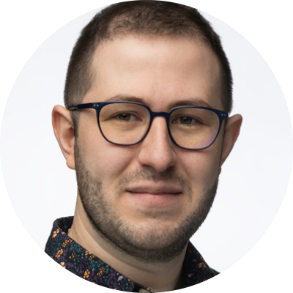
Dr. Matthew DeCross has worked for the past five years researching and implementing quantum algorithms. He received a B.S. in Physics and Mathematics from MIT and his PhD in Physics (2021) from the University of Pennsylvania studying quantum entanglement structure and quantum circuit complexity in AdS/CFT. At ³Ô¹ÏºÚÁÏÍø, he has led work on , and from random circuit sampling, and . He has also contributed to benchmarking work on ³Ô¹ÏºÚÁÏÍø's and trapped-ion quantum computers and other near-term algorithms and applications in topics such as , , and .
Get in touch
Partner with us to leverage our industry-leading full-stack quantum technologies to explore breakthroughs in drug discovery, healthcare, materials science, cybersecurity, energy transformation, and climate change.
Dr. Michael Foss Feig
Michael is a fellow physicist at ³Ô¹ÏºÚÁÏÍø working on theoretical aspects quantum computation with trapped ions.  His research is currently focused mainly on near-term applications of quantum computers, especially to solving problems in quantum many-body physics.  Before joining ³Ô¹ÏºÚÁÏÍø, Michael worked on a variety of topics at the interface of atomic physics, quantum optics, condensed-matter physics, and quantum information.