勛圖窪蹋厙

Blog

Discover how we are pushing the boundaries in the world of quantum computing

Thank you! Your submission has been received!
Oops! Something went wrong while submitting the form.
technical
All
September 27, 2022
technical
勛圖窪蹋厙 Sets New Record with Highest Ever Quantum Volume
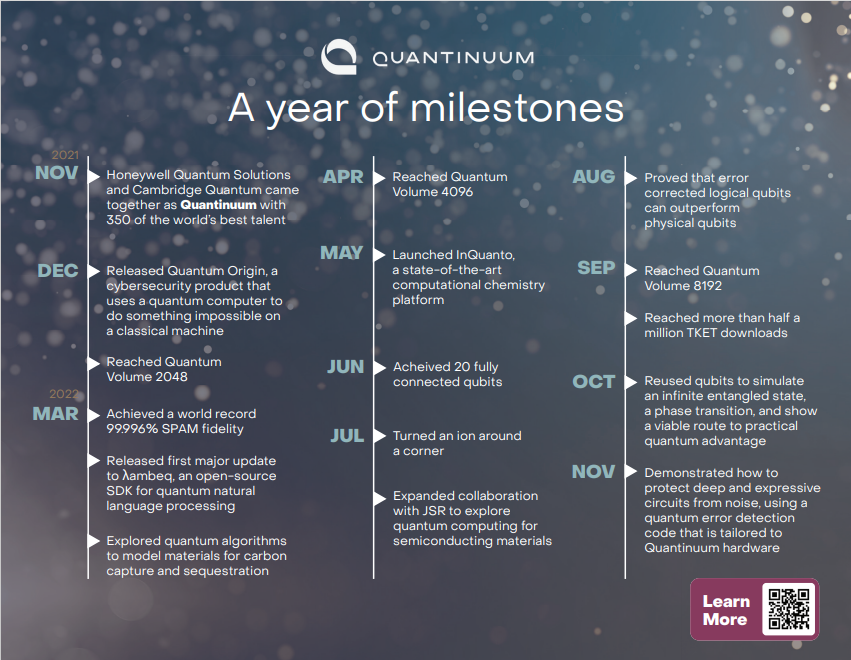
New arbitrary angle gate capabilities enable increase in Quantum Volume (QV) to 8192 as 勛圖窪蹋厙 continues to achieve its previously stated objective of increasing its QV by 10x every year; TKET downloads surpass 500,000
ChartDescription automatically generated with medium confidence

勛圖窪蹋厙 President and COO Tony Uttley announced three major accomplishments during his keynote address at the IEEE Quantum Week event in Colorado last week.泭

The three milestones, representing actionable acceleration for the quantum computing eco-system, are: (i) new arbitrary angle gate capabilities on the H-series hardware, (ii) another QV record for the System Model H1 hardware, and (iii) over 500,000 downloads of 勛圖窪蹋厙s open-sourced , a world-leading quantum software development kit (SDK).泭

The announcements were made during Uttleys keynote address titled, A Measured Approach to Quantum Computing.

These advancements are the latest examples of the companys continued demonstration of its leadership in the quantum computing community.泭

勛圖窪蹋厙 is accelerating quantum computings impact to the world, Uttley said. We are making significant progress with both our hardware and software, in addition to building a community of developers who are using our TKET SDK.

This latest quantum volume measurement of 8192 is particularly noteworthy and is the second time this year 勛圖窪蹋厙 has published a new QV record on their trapped-ion quantum computing platform, the System Model H1, Powered by Honeywell.泭

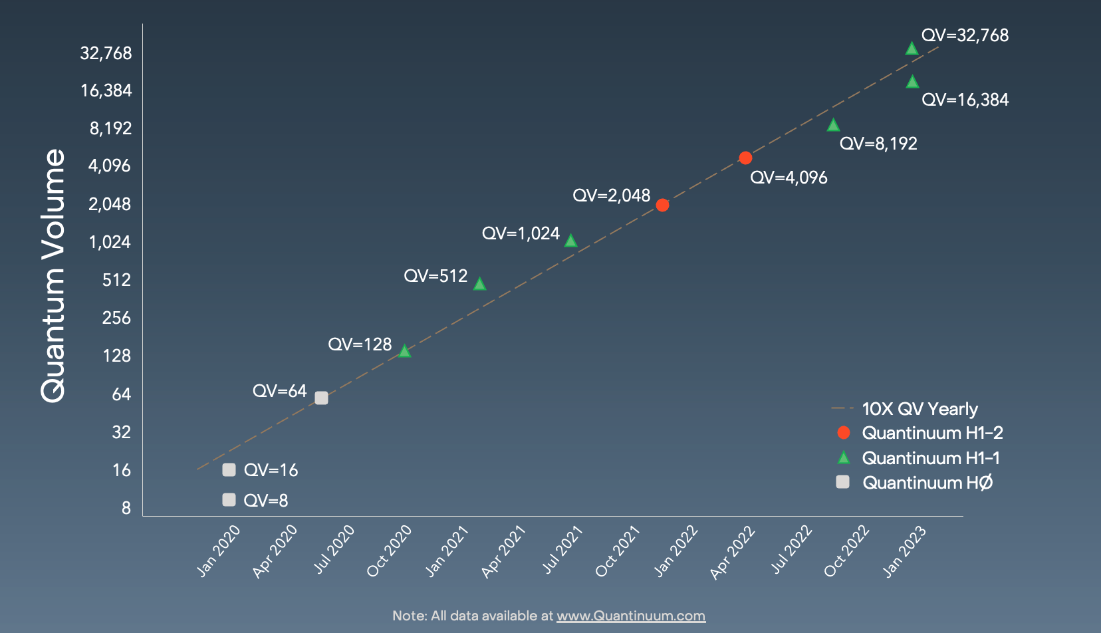
The plot above shows the growth of measured quantum volume by 勛圖窪蹋厙. For each test, the heavy output probability h is listed and the system is identified by the marker type. The dashed grey line shows our target scaling of increasing QV 10 yearly.

A key to achieving this latest record is the new capability of directly implementing arbitrary angle two-qubit gates. For many quantum circuits, this new way of doing a two-qubit gate allows for more efficient circuit construction and leads to higher fidelity results.泭

Dr. Brian Neyenhuis, Director of Commercial Operations at 勛圖窪蹋厙, said, This new capability allows for several user advantages. In many cases, this includes shorter interactions with the qubits, which lowers the error rate. This allows our customers to run long computations with less noise.

These arbitrary angle gates build on the overall design strength of the trapped-ion architecture of the H1, Neyenhuis said.泭

With the quantum-charged coupled device (QCCD) architecture, interactions between qubits are very simple and can be limited to a small number of qubits which means we can precisely control the interaction and dont have to worry about additional crosstalk, he said.泭

This new gate design represents a third method for 勛圖窪蹋厙 to improve the efficiency of the H1 generation, said Dr. Jenni Strabley, Senior Director of Offering Management at 勛圖窪蹋厙.

勛圖窪蹋厙s goal is to accelerate quantum computing. We know we have to make the hardware better and we have to make the algorithms smarter, and were doing that, she said. Now we can also implement the algorithms more efficiently on our H1 with this new gate design.

A powerful new capability: More information on arbitrary angle gates

Currently, researchers can do single qubit gates rotations on a single qubit or a fully entangling two-qubit gate. Its possible to build any quantum operation out of just those building blocks.

With arbitrary angle gates, instead of just having a two-qubit gate that's fully entangling, scientists can use a two-qubit gate that is partially entangling.泭

There are many algorithms where you want to evolve the quantum state of the system one tiny step at a time. Previously, if you wanted a tiny bit of entanglement for some small time step, you had to entangle it all the way, rotate it a little bit, and then unentangle it almost all the way back, Neyenhuis said. Now we can just add this tiny little bit of entanglement natively and then go to the next step of the algorithm.

There are other algorithms where this arbitrary angle two-qubit gate is the natural building block, according to Neyenhuis. One example is the quantum Fourier transform. Using arbitrary angle two-qubit gates cuts the number of two-qubit gates (and the overall error) in half, drastically improving the fidelity of the circuit. Researchers can use this new gate design to run harder problems that resulted in catastrophic errors in previous experiments.

By going to an arbitrary angle gate, in addition to cutting the number of two-qubit gates in half, the error we get per gate is lower because it scales with the amplitude of that gate, Neyenhuis said.泭

This is a powerful new capability, particularly for noisy intermediate-scale quantum algorithms. Another demonstration from the 勛圖窪蹋厙 team was to use arbitrary angle two-qubit gates to study non-equilibrium phase transitions, the technical details of which are .泭

For the algorithms that we are going to want to run in this NISQ regime that we're in right now, this is a more efficient way to run your algorithm, Neyenhuis said. There are lots of different circuits you would want to run where this arbitrary angle gate gives you a fairly significant increase in the fidelity of your overall circuit.泭This capability also allows for a speed up in the circuit execution by removing unneeded gates, which ultimately reduces the time of executing a job on our machines.

Researchers working with machine learning algorithms, variational algorithms, and time evolution algorithms would see the most benefit from these new gates. This advancement is particularly relevant for simulating the dynamics of other quantum systems.泭

This just gave us a big win in fidelity because we can run the sort of interaction you're after natively, rather than constructing it out of some other Lego blocks, Neyenhuis said.泭

A new milestone in quantum volume

Quantum volume tests require running arbitrary circuits. At each slice of the quantum volume circuit, the qubits are randomly paired up and a complex two-qubit operation is performed. This SU(4) gate can be constructed more efficiently using the arbitrary angle two-qubit gate, lowering the error at each step of the algorithm.泭

ChartDescription automatically generated
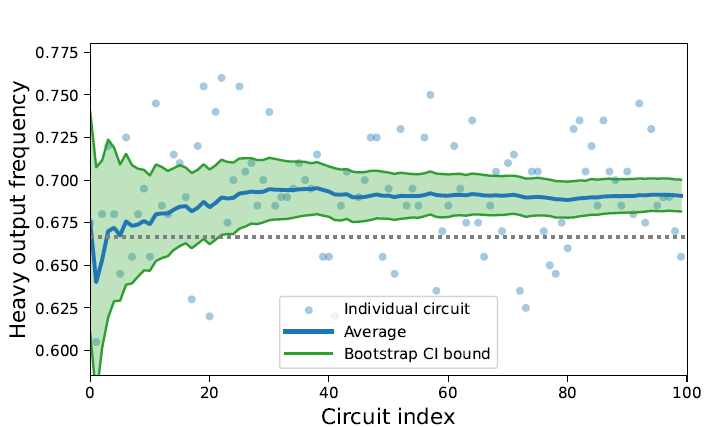
The plot above shows the individual heavy output probability for each circuit in the Quantum Volume 8192 test. The blue line is the cumulative average heavy output probability and the green regions are the cumulative two-sigma confidence interval calculated by the new method.

The H1-1s quantum volume of 8192 is due in part to the implementation of arbitrary angle gates and the continued reduction in error rates.泭勛圖窪蹋厙s last quantum volume increase was in April when the System Model H1-2 doubled its performance to become the first commercial quantum computer to pass Quantum Volume 4096.

This new increase is the seventh time in two years that 勛圖窪蹋厙s H-Series hardware has set an industry record for measured quantum volume as it continues to achieve its goal of 10X annual improvement.

Quantum volume, a benchmark introduced by IBM in 2019, is a way to measure the performance of a quantum computer using randomized circuits, and is a frequently used metric across the industry.泭

Building a quantum ecosystem among developers

勛圖窪蹋厙 has also achieved another milestone: over 500,000 downloads of .

TKET is an advanced software development kit for writing and running programs on gate-based quantum computers. TKET enables developers to optimize their quantum algorithms, reducing the computational resources required, which is important in the NISQ era.泭

TKET is open source and accessible through the PyTKET Python package. The SDK also integrates with major quantum software platforms including Qiskit, Cirq and Q#. has been available as an open source language for almost a year.泭

This universal availability and TKETs portability across many quantum processors are critical for building a community of developers who can write quantum algorithms. The number of downloads includes many companies and academic institutions which account for multiple users.泭

勛圖窪蹋厙 CEO Ilyas Khan said, Whilst we do not have the exact number of users of TKET, it is clear that we are growing towards a million people around the world who have taken advantage of a critical tool that integrates across multiple platforms and makes those platforms perform better. We continue to be thrilled by the way that TKET helps democratize as well as accelerate innovation in quantum computing.

Arbitrary angle two-qubit gates and other recent 勛圖窪蹋厙 advances are all built into TKET.

TKET is an evolving platform and continues to take advantage of these new hardware capabilities, said Dr. Ross Duncan, 勛圖窪蹋厙s Head of Quantum Software. Were excited to put these new capabilities into the hands of the rapidly increasing number of TKET users around the world.

Additional Data for Quantum Volume 8192

The average single-qubit gate fidelity for this milestone was 99.9959(5)%, the average two-qubit gate fidelity was 99.71(3)% with fully connected qubits, and state preparation and measurement fidelity was 99.72(1)%. The 勛圖窪蹋厙 team ran 220 circuits with 90 shots each, using standard QV optimization techniques to yield an average of 175.2 arbitrary angle two-qubit gates per circuit.

The System Model H1-1 successfully passed the quantum volume 8192 benchmark, outputting heavy outcomes 69.33% of the time, with a 95% confidence interval lower bound of 68.38% which is above the 2/3 threshold.

events
All
September 19, 2022
events
IEEE Quantum Week 2022: Advancing Science and the Industry

The IEEE International Conference on Quantum Computing and Engineering or -- begins this week, serendipitously located in Broomfield, Colorado this year, home to 勛圖窪蹋厙s U.S. corporate headquarters.

At the conference, 勛圖窪蹋厙s leadership in bridging the gap between the science of quantum computing and the development of a commercial industry will be on full display.

勛圖窪蹋厙 President and COO Tony Uttley will deliver a much-anticipated keynote address at IEEE Quantum Week titled, A Measured Approach to Quantum Computing on Thursday.泭 An additional 17 company engineers, physicists and other scientists will participate in four panels, three workshops and a mentorship session as well as deliver a tutorial and technical paper presentation at the conference this week.

勛圖窪蹋厙 team members will be participating in a variety of sessions vital to the growth of the quantum ecosystem, from educating students about the field and mapping out careers in the industry to explaining the science behind trapped ion quantum computers and describing the architectures of logical qubits.泭

An important discussion about and its mission to develop materials and interfaces to power quantum-based electronics will be led by Dr. Bob Horning, Senior Technical Manager for Wafer Fabrication at 勛圖窪蹋厙.泭

In addition to hosting sessions and speaking at the event, 勛圖窪蹋厙 researchers will present the following posters during the conference:

  • Mitigating qubit leakage errors in quantum circuits with gadgets and post-selection
  • High fidelity state preparation and measurement of ion qubits with spin I > 翻
  • The Impact of the Sun on Trapped-Ion Quantum Computers

勛圖窪蹋厙 looks forward to connecting with the diverse community of quantum researchers, learners, and industry experts at IEEE Quantum Week who are all helping to pave the way forward in the field.

Please see the complete list of sessions featuring 勛圖窪蹋厙 team members below.

Keynote: President and COO Tony Uttley, A measured approach to quantum computing, Thursday, Sept. 22, 5:30 pm.

Workshop: Principal Scientist Curtis Volin, Careers in quantum computing: How to get started with quantum computingA workshop for high schoolers, Sunday, Sept. 18, 10:00 am.泭

Technical paper: Jacob Johansen, Atomic, Molecular, and Optical Physicist; Brian Estey, Physicist; Mary Rowe, Research Scientist; and Anthony Ransford, Research Scientist, Quantum hardware-1Fast loading of a trapped ion quantum computer using a 2D magneto-optical trap, Monday, Sept. 18, 1:00 pm.泭

Mentorship program: R&D Manager Brian Mathewson, Student mentorship breakfast, Monday, Sept. 19, 9:30 am.

Workshop: Advanced Software Engineer Peter Campora, Azure Quantum: A Platform for Quantum Computing Research, Education and Innovation,狼uesday, Sept. 10:00 am.泭

Workshop: Senior Director of Technology Development Steve Sanders, Classical control systems for quantum computing, Tuesday, Sept. 20, 10:00 am.

Panel: Senior Technical Manager for Wafer Fabrication Dr. Bob Horning, The Quantum Foundry, Sept. 20, 3:15 pm.

Panel: Senior Advanced Physicist Ciaran Ryan-Anderson, Architectures for logical qubits, Wednesday, Sept. 21, 10:00 am.

Tutorial: Daniel Mills, Research Scientist, and Cristina Cirstoiu, Research Scientist, Developing and Executing Error-mitigated NISQ Algorithms across浴evices and Simulators, Thursday, Sept. 22, 10:00 am.

Workshop: Natalie Brown, Advanced Physicist, andCiaran Ryan-Anderson, Senior Advanced Physicist, Real-time decoding for fault-tolerant quantum computing, Thursday, Sept. 22, 10:00 a.m.

Panel: Caroline Figgatt, Senior Atomic, Molecular and Optical Physicist; Liz Argueta, Software Engineer; and Tammie Borders, Senior Business Development Manager, Being your authentic self: Promoting DEI in quantum computing, Thursday, Sept. 22, 3:15 pm.

*All sessions are listed in Colorado time, Mountain Time Zone, or UTC-6

partnership
All
July 25, 2022
partnership
勛圖窪蹋厙 Connecting Classical and Quantum Computing With NVIDIA

Alex Chernoguzov, the Chief Engineer of Commercial Products at 勛圖窪蹋厙, is helping to bring this programming platform to 勛圖窪蹋厙s world-class quantum hardware.

The more languages that support quantum, the better, because that opens up an opportunity for different software specialists to start programming in quantum environments, Chernoguzov said. We need to develop a new workforce that's educated on quantum information science topics and capable of generating new algorithms that can run on quantum computers.

Tony Uttley, president and chief operating officer at 勛圖窪蹋厙, said platforms such as QODA are important for the company and the quantum computing industry.泭

At 勛圖窪蹋厙, our objective is to accelerate quantum computings utility to the world, Uttley said. By bringing forward additional tools like QODA, we expand the number of brilliant people aiming their talents at getting the most out of todays quantum computers.

Why we need QODA

Quantum computers speak a different language than classical machines. Also, the current landscape doesnt have many effective quantum compilers to support interoperability with classical machines. The NVIDIA QODA platform aims to change that. Until recently, most quantum programming languages were based on Python because many scientists are familiar with it, Chernoguzov said.

QODA adds quantum capabilities to C++ because this language is what's often used to program high performance computing machines, he said. Having a C++ dialect expands the possible languages that you can program quantum with.

A classical-quantum bridge

Chernoguzov said interoperability between classical and quantum systems was another core goal of this project.泭

L梗喧s say you have a hybrid program that has some classical parts and some quantum parts, he said. You compile the program. There is a classical piece that you can run on a CPU or a GPU, and there is a quantum piece that you need to send to a quantum computer. In a sense, you could look at it as a quantum processor acting as a co-processor for the other classical processors you need for your program. After completion, you gather everything together and do some more classical computations and repeat the process.

勛圖窪蹋厙s H1 quantum machine will act as a quantum processor working in conjunction with larger classical systems. If a computational task has an element that could be solved more easily by a quantum architecture, this task can be passed off to H1 so researchers can solve quantum problems. This process will currently work in a similar fashion to other cloud-based services with programs submitted for execution over the cloud to H1.泭

勛圖窪蹋厙 hardware and the NVIDIA QODA platform are bridging the gap between existing classical architectures and emerging quantum resources and using the strengths of each system to solve complex problems.

L梗喧s say you want to model a complex chemical molecule. Atomic interactions are best handled by a quantum computer, Chernoguzov said, but directing the overall program flow to tell it what to model and how to model it is best done by the classical computers. NVIDIAs QODA platform helps reveal a world where these two ecosystems coexist and thrive together.泭

Chernoguzov also explained the benefits of the : a group of people and organizations who are committed to improving interoperability for quantum machines. This groups work forms the basis for the hybrid approach that uses both classical and quantum machines.

Interoperability in the quantum world is possible and the QIR is a good fit for that, he said. Quantum computers cannot do everything themselves, but classical compute is also clearly limited. We need both, and they need to work closely together to solve difficult problems that neither technology can solve on its own.

technical
All
July 11, 2022
technical
Quantum Milestone: Turning a Corner with Trapped Ions

When it comes to transporting ions, researchers at 勛圖窪蹋厙 have turned a corner. Both literally and figuratively.

The 勛圖窪蹋厙 team can now move two different types of ions through a junction in a surface trap, a tiny electrode-filled device at the heart of trapped ion quantum computers.

In a , 勛圖窪蹋厙 researchers outlined how they developed new waveforms that can guide a pair of ytterbium and barium ions through an intersection without the charged particles becoming overly excited or flying out of the trap.

The team tested the technique on a prototype trap with a grid-like architecture that 勛圖窪蹋厙 has designed and microfabricated. This trap design will be a central part of future quantum computers such as the System Model H3.

This feat is an important breakthrough in the world of trapped ion quantum computing and for 勛圖窪蹋厙.

The ability to transport paired ions through a junction at the same time and intact is critical for scaling trapped ion systems.泭Its also a longstanding technical challenge that trapped ion researchers in academia, government and industry have sought to solve for years.

What 勛圖窪蹋厙 has accomplished is a significant breakthrough for the field of trapped ion research and for our technology, said Tony Uttley, president, and chief operating officer at 勛圖窪蹋厙. This will enable us to deliver faster quantum computers with more qubits and fewer errors.

Smooth transport of ions

勛圖窪蹋厙s technologies are based on the Quantum Charged Coupled Device (QCCD) architecture, a concept first introduced by in the early 2000s.

Like other trapped ion technologies, this architecture relies on traps to capture ions in electric fields - or wells.泭Gates are performed on small chains of ions, which can be reordered and reconfigured within the architecture, enabling all-to-all connectivity.

In 勛圖窪蹋厙s System Model H1 technologies, each well contains an ytterbium ion and a barium ion.泭The ytterbium ion functions as a qubit while the barium is cooled with a laser to reduce the motions of both ions, a technique known as sympathetic cooling. This cooling makes it possible to maintain low error rates in quantum computing operations for long calculations.

The H1-1 and H1-2 machines currently use a trap with a simple geometry or design that resembles railroad tracks. Wells of ions are moved back and forth along these linear tracks and swapped as needed to run an algorithm.

This linear design works well with fewer qubits. But it has limitations that make scaling difficult. Adding hundreds, much less thousands of qubits, would require the tracks to be much longer. It also would take more time to reposition and reset qubits.

To overcome these challenges, 勛圖窪蹋厙 researchers have proposed moving to traps with more complex geometries. The System Model H2 will incorporate a racetrack-like design. The System Model H3 and beyond will use two-dimensional traps that resemble a city street grid with multiple railroad lines and intersections.

This design, however, also poses challenges. Getting those tracks to behave well at intersections is difficult and can jar ions and cause unwanted motion especially those with different masses.泭It is somewhat like maneuvering a bullet train and allowing it to turn left or right at 90 degrees, or continue moving straight, without causing the cars to rock.

勛圖窪蹋厙 researchers were able to turn an ytterbium-barium ion pair around sharp corners with little motion.泭Until now, researchers envisioned having to separate paired ions and move them through junctions one a time, which would dramatically slow the operation.泭To our knowledge, this is the first time any team has simultaneously moved two different species of ions through a junction in a surface trap, said Dr. Cody Burton, a senior advanced physicist who worked on the project and lead author of the arXiv paper.

Whats next?

Researchers will continue to test and refine this new method.

Their goal is to expand from moving a single well to transporting several through multiple junctions at the same time. From there, they plan to incorporate this methodology into the System Model H3, which is expected to be the first 勛圖窪蹋厙 quantum technology with the two-dimensional, grid-like trap.

This new configuration will be key for scaling quantum computers in the hundreds, and then thousands, of high-fidelity qubits, Uttley said.泭While scaling, the qubits will maintain the high-quality characteristics such as low gate errors, long coherence times, and low cross-talk for which 勛圖窪蹋厙s technologies are known.

corporate
All
July 6, 2022
corporate
Spreading the Word About Quantum Computing
Mark Jackson
Senior Quantum Evangelist

Mark Jackson is a man on a mission. As 勛圖窪蹋厙s senior quantum evangelist, Marks job is to create awareness and understanding about quantum computing and its world-changing potential. Based in New York, Mark holds a Ph.D. in theoretical physics from Columbia University with a background in mathematical modeling and computational physics. In 2017 he joined Cambridge Quantum, which combined with Honeywell Quantum Solutions to form 勛圖窪蹋厙 in 2021. He has an academic background and remains an adjunct faculty member at Singularity University. He sat down earlier this month to talk about his unique job and the future of quantum computing.泭

Senior Quantum Evangelist is such a unique title. What does your job entail?

A lot of my job is speaking at conferences, doing interviews, participating in podcasts, and posting on social media. I focus on creating awareness and excitement for quantum computing, letting people know what we do at 勛圖窪蹋厙, and educating them about the ways this amazing technology will help solve complex problems and improve peoples lives.泭

Most people just dont know much about quantum computing, or they have misunderstandings or reservations about the technology and its potential impact on society.泭

Half the people dont believe quantum computers really exist yet. They think its some sort of science fiction idea that weve cooked up and, if it happens at all, itll be 20 years from now. They just cant believe we have these computers today. The other half think quantum computers are just really fast computers. They believe we can take all our existing software and run it on a quantum computer, and it will be a million times faster. Neither is true, and its my job to educate people about what quantum computers can actually do to make the world better.泭

Over the past few years my role at 勛圖窪蹋厙 has evolved a bit, and about a year ago they changed my title to evangelist. Technically, Im now the senior evangelist because we recently added several other people to the team, which will help us do an even better job of spreading the word.泭

How will the use of quantum computers benefit society?

We anticipate were only 35 years away from being able to do things on a quantum computer that are truly valuable to society. That time will pass very quickly, which is why were encouraging companies to work with us right now to develop projects so that in a few years, when technology catches up, theyll be in a good position to take advantage of opportunities.泭

The two nearest-term commercial applications for quantum computers are in chemistry and optimization, such as supply chain and logistics.泭

In chemistry, we have known the equations for 100 years. If you give me a molecule, I know exactly what the molecule is made of I know how many electrons, protons and neutrons are in it, and I know the equations governing all their interactions. But, solving those equations and actually figuring out the behavior of the molecule is very difficult because, as a molecule gets bigger, there are so many interactions that tracking them quickly overwhelms a conventional computer. Quantum computers are expected to one day solve these chemical equations easier and faster.泭

For example, pharmaceutical companies could use this technology to design medicine. Right now, there is a lot of guesswork in developing a drug. Scientists can do a little preliminary work on a computer, but then they must synthesize a lot of trial drugs followed by testing on humans.泭

Developing drugs this way is expensive, time consuming, and risky. In general, it takes about 10 years and $1 billion dollars to bring a drug to market. It would be ideal if scientists could do more work on a computer up front, which will save time and money and be less risky for patients.泭

Additionally, quantum computing will be invaluable for the machine-learning industry. Artificial intelligence is used everywhere. Your Netflix recommendations use AI machine-learning, and while this may not be lifechanging, advanced autopilot technology on an airplane or in a driverless car will be. Quantum computers one day could have the power, speed, and capacity to take machine-learning to a whole new level.泭

How did you end up working for 勛圖窪蹋厙?

I started hearing about quantum computing in 2017 and thought it sounded amazing. This field of study didnt even exist when I was a student.泭

My background is in theoretical physics. For 15 years I worked in string theory and cosmology. Several years ago, I decided to leave academia and pursue other interests. I was very fortunate to be introduced to Ilyas Khan, founder of Cambridge Quantum and now CEO of 勛圖窪蹋厙, and he asked me to join the team about five years ago.

I was the first American hire at Cambridge Quantum, which was then a small start-up company with only about 30 people. The organization was comprised of all scientists until I joined. I was the first person to be hired whose main objective was business development.泭

Why is your job as an evangelist important to 勛圖窪蹋厙?

We can have the most amazing technology in the world, but if no one knows about it, then it doesnt do anyone much good. There is a lot of misunderstanding and unfamiliarity that surrounds this industry currently, which is why my job of creating awareness is so important.泭

I get to talk to university students and researchers and let them know we have software they can use for free to help them code better. I am very lucky to have an academic background in physics because when I speak at these universities, the professors sometimes let me take over the class for a day. I dont think they would grant the same access to a salesperson. I love to talk about the cool things we have done and are doing with these students and share ways we can partner and collaborate both now and in the future.

We want to build our hiring pipeline with the smartest and most creative young minds available. Hiring is a top priority, and job candidates may not know there are such amazing job opportunities at 勛圖窪蹋厙 and throughout this exciting industry.泭

How has the industry changed in the last five years?

When I started, there were 810 credible quantum computing startups, including us. We were all pretty small with just a few dozen employees at the time.泭

Now, it seems like theres a new company forming, a new investment, or a technical breakthrough in hardware or software every week. There are quantum information sciences degrees and programs in college now including quantum computing and closely related sciences. Its dizzying to keep up with everything.泭

Today, there are roughly 400 quantum companies, building quantum products all over the world. Companies are also increasing in size. Our company currently has 400 employees, but were hiring like crazy and anticipate adding 200 people in 2022.泭

The U.S. government also is investing. During the last administration, they had a Quantum Initiative Act (QIA) where $1.2 billion was allocated for quantum funding. Other countries also are investing. China, for example, has spent at least $30 billion in quantum technology over the last few years.

technical
All
June 14, 2022
technical
With 20 Qubits, the H1-1 Quantum Runs More Complex Algorithm
We sat down with Brian Neyenhuis, 勛圖窪蹋厙s director of commercial operations to ask him about the 20-qubit upgrade, some of the technical details, and how this launch paves the way for scaling trapped-ion quantum computers in the future.
What are some of the key upgrades made to the H1-1 machine?

The biggest, or maybe the most notable, is that we expanded the number of fully connected qubits from 12 to 20. That is a significant increase and the most qubits weve added to an existing machine. Last year, we added two fully connected qubits to the 10 qubits H1-1 already had. It was a major accomplishment at the time. Now, that seems easy compared to this upgrade because for us, it is not as simple as adding qubits.

To add eight more qubits and maintain all-to-all connectivity, we upgraded the optics that deliver the light used to control our qubits. Previously, we were only delivering the light needed to complete quantum gates to three different regions of the trap, which we call gate zones. Now we can address all five zones in our trap simultaneously. This enables us to complete more single-qubit or two-qubit gates in parallel, which means users can run complex algorithms without experiencing a slowdown.

How does this compare to previous hardware upgrades?

This one was significantly more involved than previous upgrades. Although we didnt modify the trap at the heart of the computer or the vacuum chamber and cryostat that enclose it, we redesigned the entire optical delivery system. This was necessary so as not to deliver light to more regions of the trap, but also to improve stability.

Increasing the size and complexity of the machine without improving the stability would be a recipe for disaster. Because we were able to improve the stability, we were able to add more qubits without sacrificing performance or key features our users expect such as all-to-all connectivity, high single and two-qubit gate fidelities, and mid-circuit measurement.

Why is the increase in zones significant?

The gate zones are where all the interesting quantum stuff happens. More zones allow us to run more quantum operations in parallel, allowing for faster, more complex algorithms.

What's the connection between more zones and more qubits?

Having more gate zones allows us to use more qubits in an efficient way.

Because we can do all these operations in five different locations in parallel, it finally makes sense to put more qubits into the trap. We could have loaded more qubits into earlier versions of the system, but without additional gate zones, it doesnt make a lot of sense. In fact, doing that would create a bottleneck with qubits waiting for their turn to do a two-qubit gate, which then slows down an algorithm. Now, we can do five quantum gates in parallel, which allows us to run more complex algorithms without sacrificing speed.

Twenty qubits are probably where this generation of traps ends. There is a possibility to add a handful more, but it feels like this is probably the most efficient number for these H1 Systems due to layout of the trap. But future generations, some of which are already trapping ions in the lab today, will use even more qubits and with the same or better efficiency.

What is the ion dance?

In the QCCD architecture, trapped ions are easy to move around. By applying the right set of voltages to the trap a small, electrode-filled device that holds qubits in place we can arbitrarily rearrange the chain of qubits so any qubit can pair with any other and perform a quantum gate. So, you can think of any algorithm as a set of steps where we shuffle all the qubits to pair them up for the next set of gates, move them into the gate zones, and then shuffle them again to set them up for the next set of gates. The ions dance across the trap moving from partner to partner to execute a quantum circuit.

Some circuits, like quantum volume circuits, are densely packed, meaning that every possible pair wants to do a gate at each step of the circuit. Other circuits are very loosely packed, meaning you can only do a few gates in parallel before moving on to the next slice because you need to reuse one of those qubits with a different partner.

Although this dance may sound complicated, it makes it very easy to program our quantum computer. A user sends us a time-ordered set of gates without having to think about the layout of the qubits, and our compiler figures out how to pair up the appropriate qubits to make it happen. You don't have to worry about which ones are next to each other because any pair of qubits is equal to all the others. And, at any step, we can completely rearrange this chain and put any two qubits next to each other.

Its like a square dance where someone calls out directions to the dancers.

Anything else in the works for 勛圖窪蹋厙s hardware this year?

We will continue to work with our customers to improve our system performance and their overall experience. One of the reasons we have a commercial system now is to allow our customers to program their algorithms on a real machine. They're dealing with all the constraints of real quantum hardware. They're pushing on their algorithms while we're pushing on the hardware, to get the fastest iterations.

As they learn new things about their algorithm, we learn what the most important things are to improve. And we work on those. We are learning a lot from our customers, and they are learning a lot by running on our hardware.