³Ô¹ÏºÚÁÏÍø’s H-Series hits 56 physical qubits that are all-to-all connected, and departs the era of classical simulation
In collaboration with JPMorgan Chase & Co., ³Ô¹ÏºÚÁÏÍø’s H2-1 achieved a massive uplift in an iconic demonstration
June 5, 2024
The first half of 2024 will go down as the period when we shed the last vestiges of the “wait and see� culture that has dominated the quantum computing industry. Thanks to a run of recent achievements, we have helped to lead the entire quantum computing industry into a new, post-classical era.
Today we are announcing the latest of these achievements: a major qubit count enhancement to our flagship System Model H2 quantum computer from 32 to 56 qubits. We also reveal meaningful results of work with our partner JPMorgan Chase & Co. that showcases a significant lift in performance.
But to understand the full importance of today’s announcements, it is worth recapping the succession of breakthroughs that confirm that we are entering a new era of quantum computing in which classical simulation will be infeasible.
A historic run
Between January and June 2024, ³Ô¹ÏºÚÁÏÍø’s pioneering teams published a succession of results that accelerate our path to universal fault-tolerant quantum computing.Â
Our technical teams first presented a long-sought solution to the “wiring problem�, an engineering challenge that affects all types of quantum computers. In short, most current designs will require an impossible number of wires connected to the quantum processor to scale to large qubit numbers. Our solution allows us to scale to high qubit numbers with no issues, proving that our QCCD architecture has the potential to scale.
Next, we became the first quantum computing company in the world to hit “three 9s� two qubit gate fidelity across all qubit pairs in a production device. This level of fidelity in 2-qubit gate operations was long thought to herald the point at which error corrected quantum computing could become a reality. It has accelerated and intensified our focus on quantum error correction (QEC). Our scientists and engineers are working with our customers and partners to achieve multiple breakthroughs in QEC in the coming months, many of which will be incorporated into products such as the H-Series and our chemistry simulation platform, InQuanto™.
Following that, with our long-time partner Microsoft, we hit an error correction performance threshold that many believed was still years away. The System Model H2 became the first – and only – quantum computer in the world capable of creating and computing with highly reliable logical (error corrected) qubits. In this demonstration, the H2-1 configured with 32 physical qubits supported the creation of four highly reliable logical qubits operating at “better than break-even�. In the same demonstration, we also shared that logical circuit error rates were shown to be up to 800x lower than the corresponding physical circuit error rates. No other quantum computing company is even close to matching this achievement (despite many feverish claims in the past 12 months).
Pushing to the limits of supercomputing … and beyond
The quantum computing industry is departing the era when quantum computers could be simulated by a classical computer. Today, we are making two milestone announcements. The first is that our H2-1 processor has been upgraded to 56 trapped-ion qubits, making it impossible to classically simulate, without any loss of the market-leading fidelity, all-to-all qubit connectivity, mid-circuit measurement, qubit reuse, and feed forward.
The second is that the upgrade of H2-1 from 32 to 56 qubits makes our processor capable of challenging the world’s most powerful supercomputers. This demonstration was achieved in partnership with our long-term collaborator JPMorgan Chase & Co. and researchers from Caltech and Argonne National Lab.
Our collaboration tackled a well-known algorithm, , and measured the quality of our results with a suite of tests including the linear cross entropy benchmark (XEB) – an approach first made famous by Google in 2019 in a bid to demonstrate “quantum supremacy�. An XEB score close to 0 says your results are noisy – and do not utilize the full potential of quantum computing. In contrast, the closer an XEB score is to 1, the more your results demonstrate the power of quantum computing. The results on H2-1 are excellent, revealing, and worth exploring in a little detail. Here is the complete .
Better qubits, better results
Our results show how far quantum hardware has come since Google’s initial demonstration. They originally ran circuits on 53 superconducting qubits that were deep enough to severely frustrate high-fidelity classical simulation at the time, achieving an estimated XEB score of ~0.002. While they showed that this small value was statistically inconsistent with zero, improvements in classical algorithms and hardware have steadily increased what XEB scores are achievable by classical computers, to the point that classical computers can now achieve scores similar to Google’s on their original circuits.
Figure 1. At N=56 qubits, the H2 quantum computer achieves over 100x higher fidelity on computationally hard circuits compared to earlier superconducting experiments. This means orders of magnitude fewer shots are required for high confidence in the fidelity, resulting in comparable total runtimes
In contrast, we have been able to run circuits on all 56 qubits in H2-1 that are deep enough to challenge high-fidelity classical simulation while achieving an estimated XEB score of ~0.35. This >100x improvement implies the following: even for circuits large and complex enough to frustrate all known classical simulation methods, the H2 quantum computer produces results without making even a single error about 35% of the time. In contrast to past announcements associated with XEB experiments, 35% is a significant step towards the idealized 100% fidelity limit in which the computational advantage of quantum computers is clearly in sight.
This huge jump in quality is made possible by ³Ô¹ÏºÚÁÏÍø’s market-leading high fidelity and also our unique all-to-all connectivity. Our flexible connectivity, enabled by , enables us to implement circuits with much more complex geometries than the 2D geometries supported by superconducting-based quantum computers. This specific advantage means our quantum circuits become difficult to simulate classically with significantly fewer operations (or gates). These capabilities have an enormous impact on how our computational power scales as we add more qubits: since noisy quantum computers can only run a limited number of gates before returning unusable results, needing to run fewer gates ultimately translates into solving complex tasks with consistent and dependable accuracy.
This is a vitally important moment for companies and governments watching this space and deciding when to invest in quantum: these results underscore both the performance capabilities and the rapid rate of improvement of our processors, especially the System Model H2, as a prime candidate for achieving near-term value.
So what of the comparison between the H2-1 results and a classical supercomputer?Â
A direct comparison can be made between the time it took H2-1 to perform RCS and the time it took a classical supercomputer. However, classical simulations of RCS can be made faster by building a larger supercomputer (or by distributing the workload across many existing supercomputers). A more robust comparison is to consider the amount of energy that must be expended to perform RCS on either H2-1 or on classical computing hardware, which ultimately controls the real cost of performing RCS. An analysis based on the most efficient known classical algorithm for RCS and the power consumption of leading supercomputers indicates that H2-1 can perform RCS at 56 qubits with an estimated 30,000x reduction in power consumption. These early results should be seen as very attractive for data center owners and supercomputing facilities looking to add quantum computers as “acceleratorsâ€� for their users.Â
Where we go next
Today’s milestone announcements are clear evidence that the H2-1 quantum processor can perform computational tasks with far greater efficiency than classical computers. They underpin the expectation that as our quantum computers scale beyond today’s 56 qubits to hundreds, thousands, and eventually millions of high-quality qubits, classical supercomputers will quickly fall behind. ³Ô¹ÏºÚÁÏÍø’s quantum computers are likely to become the device of choice as scrutiny continues to grow of the power consumption of classical computers applied to highly intensive workloads such as simulating molecules and material structures – tasks that are widely expected to be amenable to a speedup using quantum computers.
With this upgrade in our qubit count to 56, we will no longer be offering a commercial “fully encompassing� emulator – a mathematically exact simulation of our H2-1 quantum processor is now impossible, as it would take up the entire memory of the world’s best supercomputers. With 56 qubits, the only way to get exact results is to run on the actual hardware, a trend the leaders in this field have already embraced.
More generally, this work demonstrates that connectivity, fidelity, and speed are all interconnected when measuring the power of a quantum computer. Our competitive edge will persist in the long run; as we move to running more algorithms at the logical level, connectivity and fidelity will continue to play a crucial role in performance.
“We are entirely focused on the path to universal fault tolerant quantum computers. This objective has not changed, but what has changed in the past few months is clear evidence of the advances that have been made possible due to the work and the investment that has been made over many, many years. These results show that whilst the full benefits of fault tolerant quantum computers have not changed in nature, they may be reachable earlier than was originally expected, and crucially, that along the way, there will be tangible benefits to our customers in their day-to-day operations as quantum computers start to perform in ways that are not classically simulatable. We have an exciting few months ahead of us as we unveil some of the applications that will start to matter in this context with our partners across a number of sectors.� – Ilyas Khan, Chief Product Officer
Stay tuned for results in error correction, physics, chemistry and more on our new 56-qubit processor.
About ³Ô¹ÏºÚÁÏÍø
³Ô¹ÏºÚÁÏÍø, the world’s largest integrated quantum company, pioneers powerful quantum computers and advanced software solutions. ³Ô¹ÏºÚÁÏÍø’s technology drives breakthroughs in materials discovery, cybersecurity, and next-gen quantum AI. With over 500 employees, including 370+ scientists and engineers, ³Ô¹ÏºÚÁÏÍø leads the quantum computing revolution across continents.Â
Blog
|
corporate
October 22, 2026
³Ô¹ÏºÚÁÏÍø and Oracle Advance Hybrid Quantum-AI Computing with Early Access to Helios
From Oracle's Quantum AI Compute beta program to upcoming Helios installation milestones and Oracle AI World, our partnership continues to gain momentum.
When ³Ô¹ÏºÚÁÏÍø and Oracle announced a strategic partnership earlier this year, the goal was not simply to deploy a quantum computer in the cloud. It was to create a practical path for bringing quantum computing into the enterprise environments where AI, data, and high-performance computing (HPC) already come together. Â
By combining Oracle Cloud Infrastructure (OCI)'s AI, data, and cloud capabilities with Helios, ³Ô¹ÏºÚÁÏÍø's most advanced quantum computer, we're helping lay the foundation for hybrid quantum AI computing at enterprise scale. The partnership reflects our belief that some of the most valuable future applications will emerge when quantum computing, AI and classical HPC work together to tackle problems that remain difficult to solve today. Â
Oracle Opens Early Access for Quantum AI Compute
That vision is now being put into practice. This month, Oracle launched the , giving select organizations an opportunity to begin evaluating how quantum computing fits into existing workflows and computational challenges.
Through the program, approved participants will gain cloud-based access to Helios, the world's most accurate commercial quantum computer, alongside OCI's GPU and HPC infrastructure. For organizations exploring quantum computing, this creates a practical starting point: access to industry-leading hardware within an enterprise cloud environment, without the need to build specialized infrastructure of their own.
The goal is to help organizations understand where hybrid quantum AI workflows may create value across areas such as drug discovery, materials science, energy, financial modeling, and optimization.
For many organizations, the starting point is not quantum technology itself. It's a business or research problem. Where are today's approaches reaching meaningful limits? Which workloads consume disproportionate resources? And where could a new computational capability create an advantage?
Organizations interested in participating can apply through Oracle's OCI Preview Programs . Oracle will review applications and select participants based on eligibility, capacity and program requirements.
³Ô¹ÏºÚÁÏÍø and Oracle Leadership Takes the Stage at Oracle AI World
The opportunity for hybrid quantum-AI computing will be a major topic at . Â
In a main stage session, "," Larry Stack, Chief Commercial Officer at ³Ô¹ÏºÚÁÏÍø, will join Mahesh Thiagarajan, Executive Vice President and Head of Oracle Cloud Infrastructure, to discuss how quantum computing, AI and classical HPC can work together to address some of the world's most computationally demanding challenges.
The discussion will focus on a core question many organizations are asking: where should they start? Rather than leading with technology, the conversation will explore how organizations can identify high-value problems, establish today's performance baseline, and evaluate where quantum computing ultimately provides an advantage.
Later in the day, ³Ô¹ÏºÚÁÏÍø and Oracle experts will at how bringing Helios into OCI provides managed access to quantum computing natively within an enterprise cloud environment to support hybrid quantum-AI workflows.
Building Momentum Toward Hybrid Quantum-AI Computing
The collaboration between ³Ô¹ÏºÚÁÏÍø and Oracle continues to progress from vision to execution.
With Helios advancing toward installation, Oracle's Quantum AI Compute program now open for early access, and enterprise interest growing around hybrid computing, the pieces are coming together. Organizations now have a practical way to begin exploring quantum computing through cloud-based access to Helios alongside AI, HPC, and existing enterprise workflows.
We look forward to continuing the conversation at Oracle AI World 2026 and working with customers who want to better understand where hybrid quantum-AI computing can create real-world value.
We're excited to continue that conversation at Oracle AI World 2026 and to help customers begin exploring what's possible through the OCI Quantum AI Compute Beta Program.
³Ô¹ÏºÚÁÏÍø and Google: Two Fault-Tolerance Results, Two Different Measures of Progress
By: David Hayes, Sr. Director of Computational Design and Integrated Software
Two recent announcements from ³Ô¹ÏºÚÁÏÍø and Google mark important progress toward fault-tolerant quantum computing.
Because both announcements focus on reducing errors, it may be tempting to compare the numbers directly. But these results are not the same. They measure different parts of the fault-tolerance challenge and answer fundamentally different technical questions.
This week, we a world-record error-correction result, using our error-correction architecture on Helios to deliver a logical fidelity of 99.9995%, equivalent to just five errors per million operations and representing a 100x reduction in errors compared to the best published result across any other modality—reported by . Â
Last week, Google a 99.99% magic-state fidelity result using a new cultivation technique, citing a 40x reduction in errors.
As fault-tolerant quantum computing matures, understanding what is being measured becomes just as important as understanding the headline number itself. Google's work measured the fidelity of a resource used in certain fault-tolerant operations. Our work measured the fidelity of the logical computation that consumes those resources.
Across the published results, ³Ô¹ÏºÚÁÏÍø demonstrates state-of-the-art performance in fault-tolerance, combining record logical computational fidelity with substantial advantages in resource efficiency. Understanding starts with examining what each study measured, what it achieved, and the resources it required.
³Ô¹ÏºÚÁÏÍø's World-Record Result: Measuring the Accuracy of a Logical Computation
This week’s result measured how accurately an error-corrected logical quantum system can execute a computation.
To achieve the result, we used a well-known “color codeâ€� within our error-correction architecture. The error rate is 10 times lower than ³Ô¹ÏºÚÁÏÍø’s own world record achieved last month and 100 times lower than the best published result across all other hardware modalities—the 2024 Google result.
The study also demonstrated that logical errors fell exponentially as code distance increased. Code distance is a key measure of how quantum information can be protected as an error-correction system scales.
Each increase tested in the study reduced the remaining logical error rate by a record factor of 12, demonstrating exponentially effective error suppression as the code grows, a critical capability for scalable fault-tolerant quantum computing.
Together, these results demonstrate how ³Ô¹ÏºÚÁÏÍø's highly accurate trapped-ion hardware and flexible logical architecture can drive rapid gains in computational accuracy. They also show that fault-tolerant performance can be achieved with substantially fewer physical qubits than competing modalities.
The result places ³Ô¹ÏºÚÁÏÍø within the target logical-performance range required for Apollo, our planned universal fault-tolerant quantum computer targeted for 2029.
Google's latest paper focused on a different aspect of fault tolerance: the preparation of high-fidelity magic states.
Magic states are an important resource required for certain operations in a fault-tolerant quantum computer. Generating them efficiently is widely recognized as one of the key engineering challenges facing large-scale fault-tolerant systems, particularly for certain modalities.
Google's work introduced a new approach known as cultivation, designed to improve the fidelity of magic-state preparation while reducing the resources required to produce those states. The study demonstrated a magic-state fidelity of 99.99% using a protocol that retained approximately 8% of attempts while discarding the remainder. This post-selection process was a key contributor to the reported 40x reduction in error rate.
The study did not measure the fidelity of a larger logical computation that incorporates those magic states into an end-to-end algorithm. Instead, it focused specifically on the creation and refinement of the resource itself.
That distinction is important because preparing a high-fidelity resource and demonstrating the performance of a logical computation are different milestones on the path to fault tolerance.
Directly Comparing ³Ô¹ÏºÚÁÏÍø and Google’s Magic-State Results
³Ô¹ÏºÚÁÏÍø's latest logical computation result should not be compared directly with Google's latest magic-state result. It should be compared against the distance scaling result published by Google in 2024.
That said, we have published studies measuring an analogous magic-state capability examined in Google’s latest work.
, we achieved 99.993% magic-state fidelity with an 85% retention rate, compared with the 99.99% fidelity and approximately 8% retention reported in Google’s latest work. Our result also required fewer physical qubits and fewer operational steps, resulting in significantly lower space-time overhead.
That combination of smaller qubit and operational steps footprint, along with substantially higher retention means fewer resources are consumed preparing each usable magic state.
As fault-tolerant systems scale, those efficiency advantages become increasingly important because they directly affect the amount of hardware required to perform useful computations.
The Bigger Picture
Taken together, these results establish ³Ô¹ÏºÚÁÏÍø’s leadership in demonstrated fault-tolerant performance: record logical computation fidelity, alongside a directly comparable magic-state result that achieves higher fidelity with substantially lower resource overhead.
That combination—computational accuracy and the efficiency with which it is achieved—is critical to delivering reliable answers to useful problems at a practical scale.
Ultimately, customers do not buy two-qubit gate fidelities or magic states. They buy answers.
Forward-Looking Statements
This blog post contains forward-looking statements within the meaning of the Private Securities Litigation Reform Act of 1995. These include statements about our technology roadmap, our expected logical performance, and the planned timing and capabilities of future systems, including Apollo. Words such as "target," "expect," "plan," and similar expressions identify forward-looking statements. These statements are based on our current expectations and involve risks and uncertainties that could cause actual results to differ materially. Those risks include challenges in developing, manufacturing, and scaling our quantum computing systems. For a discussion of these and other risks, see the "Risk Factors" section of our most recent Quarterly Report on Form 10-Q and our other filings with the SEC, available at ir.quantinuum.com. Forward-looking statements speak only as of the date of this post, and we undertake no obligation to update them except as required by law.
³Ô¹ÏºÚÁÏÍø Closes In on One Million Error-Free Operations
Record accuracy: Using ³Ô¹ÏºÚÁÏÍø’s logical error-correction architecture, Helios achieved a logical memory fidelity of 99.9995%—just five uncorrectable errors per million operations—reducing logical memory errors tenfold compared with ³Ô¹ÏºÚÁÏÍø’s September record and more than 100-fold compared with the superconducting record.
Errors fall exponentially as protection grows: Each tested increase in code distance reduced logical memory errors by an average factor of 12, and logical gate errors by an average factor of 9, demonstrating the exponential error suppression needed to scale toward longer, more reliable quantum computations.
A flexible path to fault tolerance: Successive breakthroughs using different codes within the same logical architecture, on the same commercial Helios hardware, demonstrate how accuracy and qubit efficiency can be optimized as ³Ô¹ÏºÚÁÏÍø advances toward Apollo in 2029.
To truly leave the NISQ era, though, we need to demonstrate a “megaquopâ€� machine – a quantum computer that can run over a million operations error-free. With our latest result, we are on the cusp of this monumental achievement: using ³Ô¹ÏºÚÁÏÍø’s logical error-correction architecture, Helios achieved a logical memory fidelity of 99.9995%— or a million operations with only 5 uncorrectable errors, a new world record. This logical error rate is ten times lower than our September record and more than 100 times lower than the record achieved on a superconducting system.
Coming after September’s Helix-code demonstration on the same Helios hardware, this result shows how our flexible logical architecture and highly accurate trapped-ion technology support rapid improvements in accuracy.
These results indicate that an Apollo-scale machine could reach the fault-tolerant quantum advantage regime using 30x fewer physical qubits than other leading approaches, reinforcing our path to Apollo, our first universal fault-tolerant quantum computer.
A quantum memory that lasts
At ³Ô¹ÏºÚÁÏÍø, we don’t have delicate qubits that can only hold their state for milliseconds at a time. . However, this latest result takes it to a whole new level: we have demonstrated the most robust quantum memory ever recorded.
This latest result was enabled by something scientists call “distance scaling�, a key result in quantum error correction (QEC) theory: the prediction that error rates should be suppressed exponentially as longer distance codes (more physical qubits per logical qubit) are used.
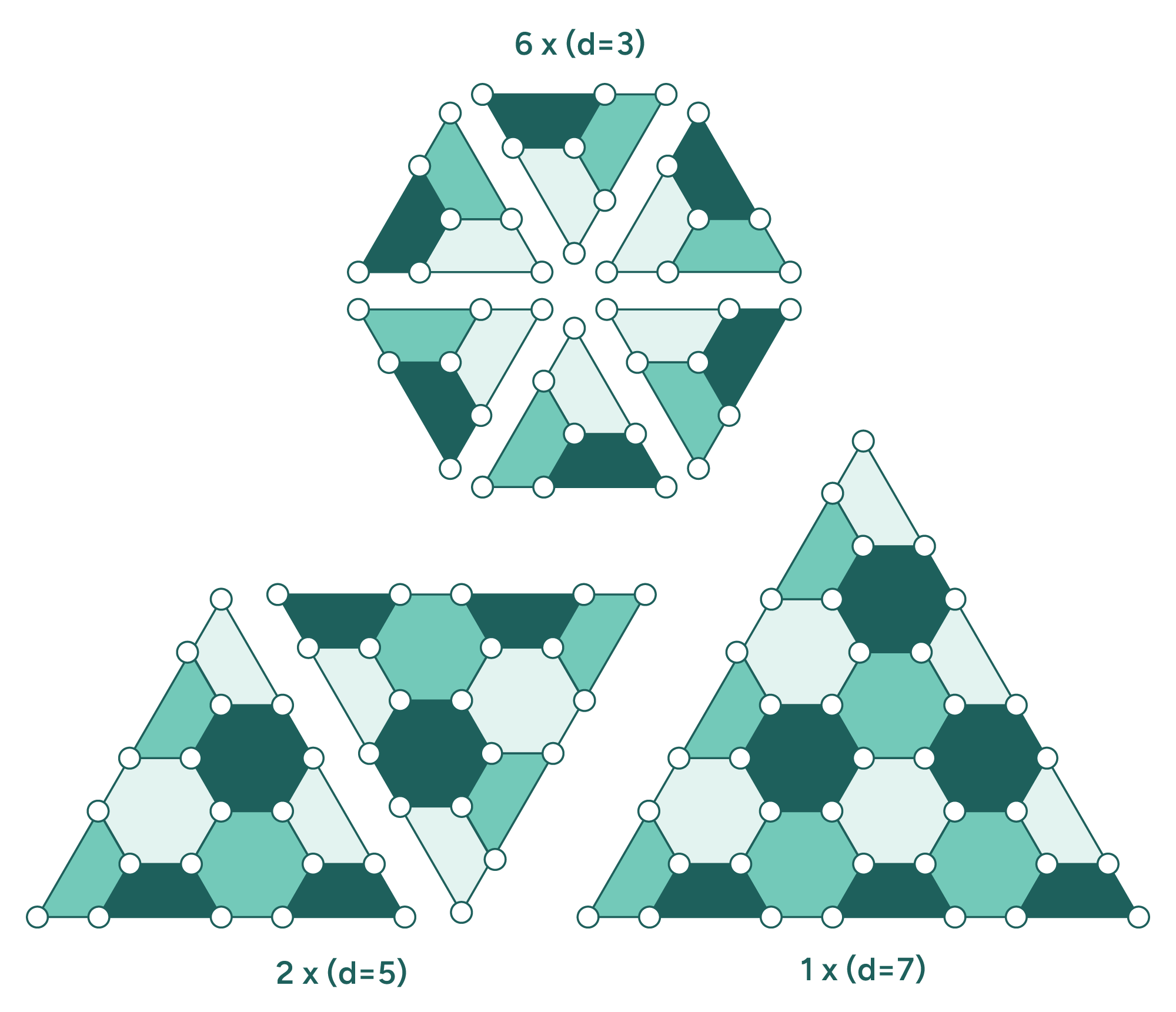
�Figure 1. The three logical qubit constructions used for distance 3, 5, and 7 memory experiments. The white circles represent physical qubits.
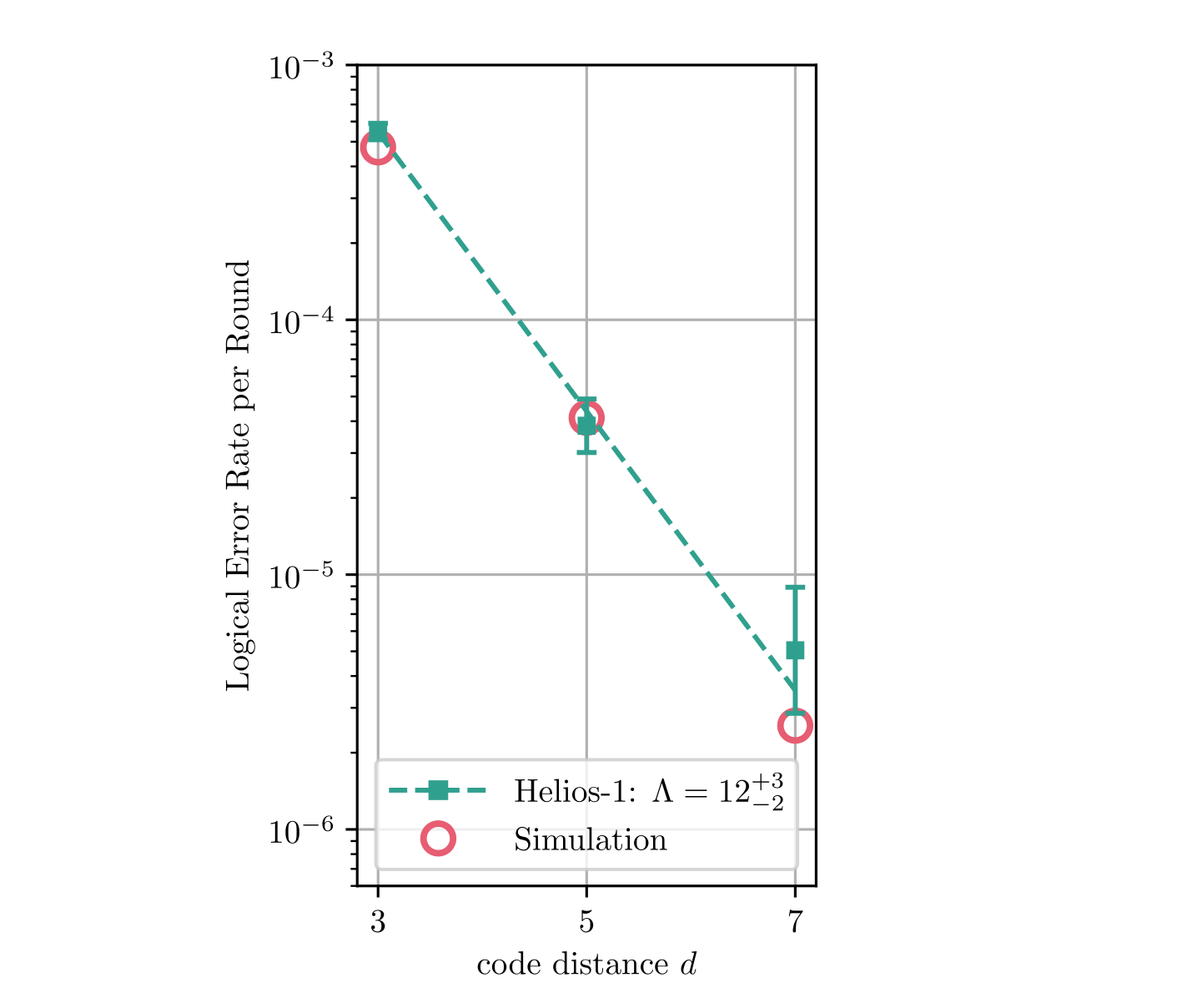
In experiments using color codes of distance 3, 5 and 7, Helios (with code written in Guppy) reduced the logical failure rate by an average factor of 12 each time the code distance increased. At distance 7, the system achieved a logical fidelity of 99.9995% per syndrome-extraction cycle, equivalent to a failure probability of just 5 × 10��. This nearly “six nines� result sets a new record for logical accuracy through quantum error correction.
Figure 2. Experimental data and simulation results showing the logical error per round at code distances of 3, 5, and 7. The slope of the line is given by  Λ , indicating that logical errors are suppressed by a factor of 12 for each step in code distance.
To measure the failure rate of something that rarely fails, you must run it for a long time. This ensures that you get reasonable enough statistics to feel comfortable that your measured value isn’t just a statistical fluctuation (scientists call this 'averaging down’ the uncertainty in your measurement).
When you only get an error 5 times in a million rounds, this often means ‘averaging down’ for a long time to even see an error2.
“We felt a mix of excitement and suspense every time the results came in. When errors are this rare, each one really matters."
- Dr. Adam Reed, Lead Physicist, Commercial Operations
More than a memory: high-fidelity logical gates
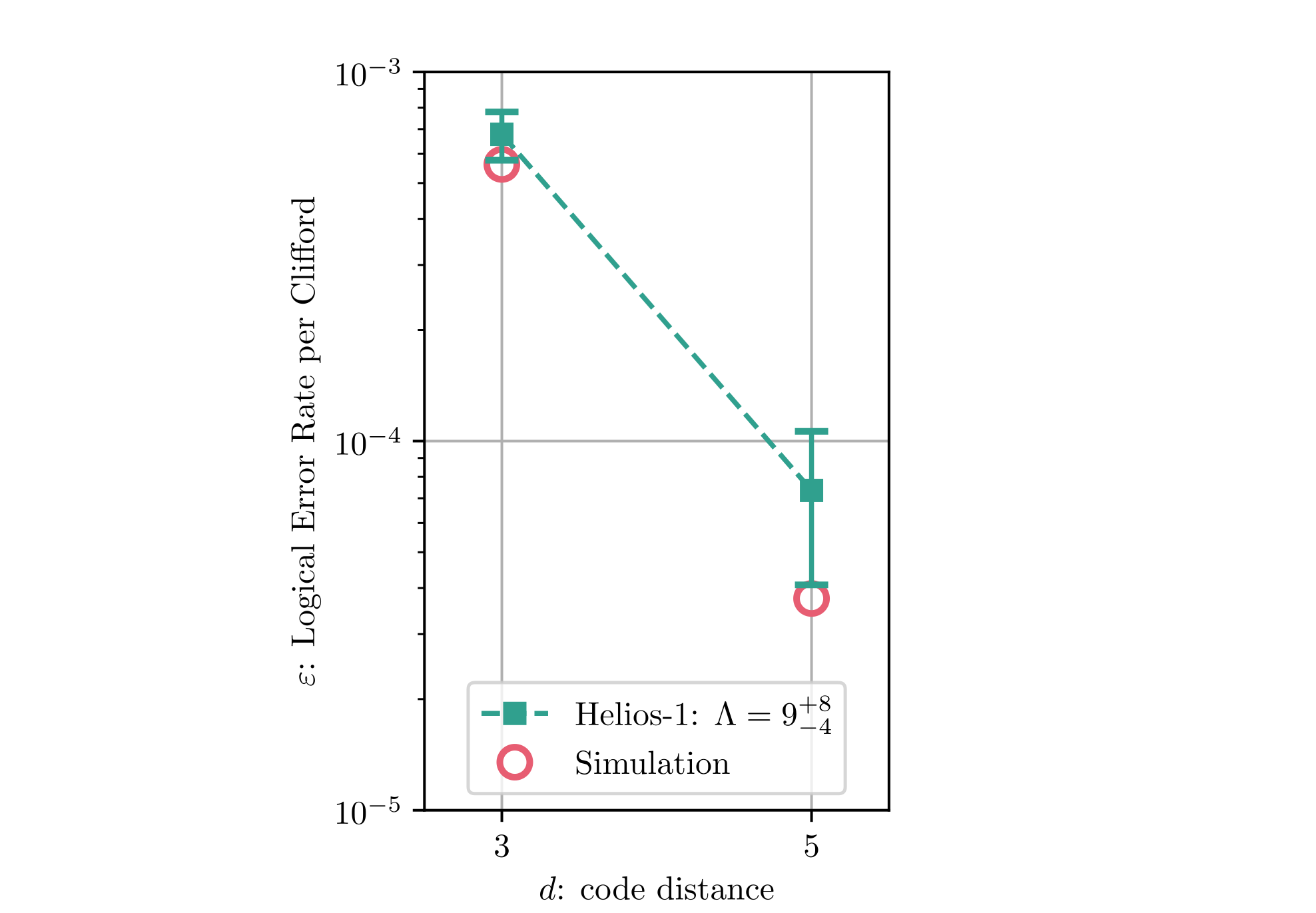
The team also explored logical computation, measuring 2-qubit Clifford gate fidelity at increasing code distance. In this case, the team measured a suppression factor Λ of 9 when stepping the code distance up from 3 to 5, proving again our hardware’s exponential error suppression3.
Figure 3. Experimental data and simulation results showing the logical Clifford error per round at code distances of 3 and 5. The slope of the line is given by Λ, indicating that logical errors are suppressed by a factor of 9 for each step in code distance.
If one assumes a “Clifford + T� model of universal computation (with T gates teleported via magic state injection), then a fully fault tolerant processor built with this code will have three crucial components:
Magic state preparation
Two-qubit Clifford gates
Syndrome extraction gadgets.
This work demonstrates high accuracy implementation and below threshold scaling of the latter two, and we demonstrated the first in a separate paper () back in 2025.  Teleporting T gates via magic state injection will require real-time decoding, which we and have been refining ever since – in fact, this work shows that this is viable for near-optimal decoders. There is still work to be done, however: nobody has yet demonstrated below threshold scaling for magic state preparation.
We’ve already put almost everything together in the Helix code. Soon, we will be integrating all these color-code components into increasingly large, reliable computations. Our ability to fully employ multiple codes is a testament to our powerful error correction architecture.
World-record logical fidelities come from world-leading physical fidelities�
Distance scaling is great in theory, but it because it only works when the underlying hardware noise falls below a certain threshold. This is known as the “threshold theorem.� Basically, until the physical layer has low enough noise levels, QEC will just add more noise than it takes away.
Helios’ incredible performance – with a ‘suppression rate’ Λ of 12 (for memory) and 9 (for Clifford gates) - is a clear demonstration of our world-leading physical fidelity, which puts us well below the ‘threshold’.
The rate Λ captures the exponential suppression in error rate with increasing code distance4: increasing the code distance once gives an 12x reduction in logical error, increasing the distance twice gives 144x, three times 1728x, and so on. In contrast, a machine with a Λ of 2 gives you a 2x reduction, then a 4x reduction, then 8x, and so on – a much slower gain. The magnitude of Λ is crucial for how well quantum computers can scale, and this is the largest Λ ever measured.
This effect shows up in the best error rates, too. . Helios, in contrast, showed an error rate of 0.0005% with a distance 7 code, a 1,638x improvement5. This massive improvement is due to our excellent physical fidelity, improved scaling behavior, and our ability to go to a longer distance code (in this case, d=7 vs d=5)6.
, the previous best demonstrated error rate was using a surface code. In this case, the researchers demonstrated an error rate of 0.0772% per cycle with a distance 7 code. In this case, Helios shows a 154x improvement7.
�
Figure 4. Animation of logical qubit growth with increasing code distance. The white circles represent physical qubits, and the animation shows how logical qubits are formed at color code distances of 3, 5, and 7.
Our trapped-ion qubits lead to significant resource savings
On top of our new record in fidelity, the scaling with code distance reveals something very important: our QCCD8 approach is expected to reach utility scale with far less resources than other modalities.
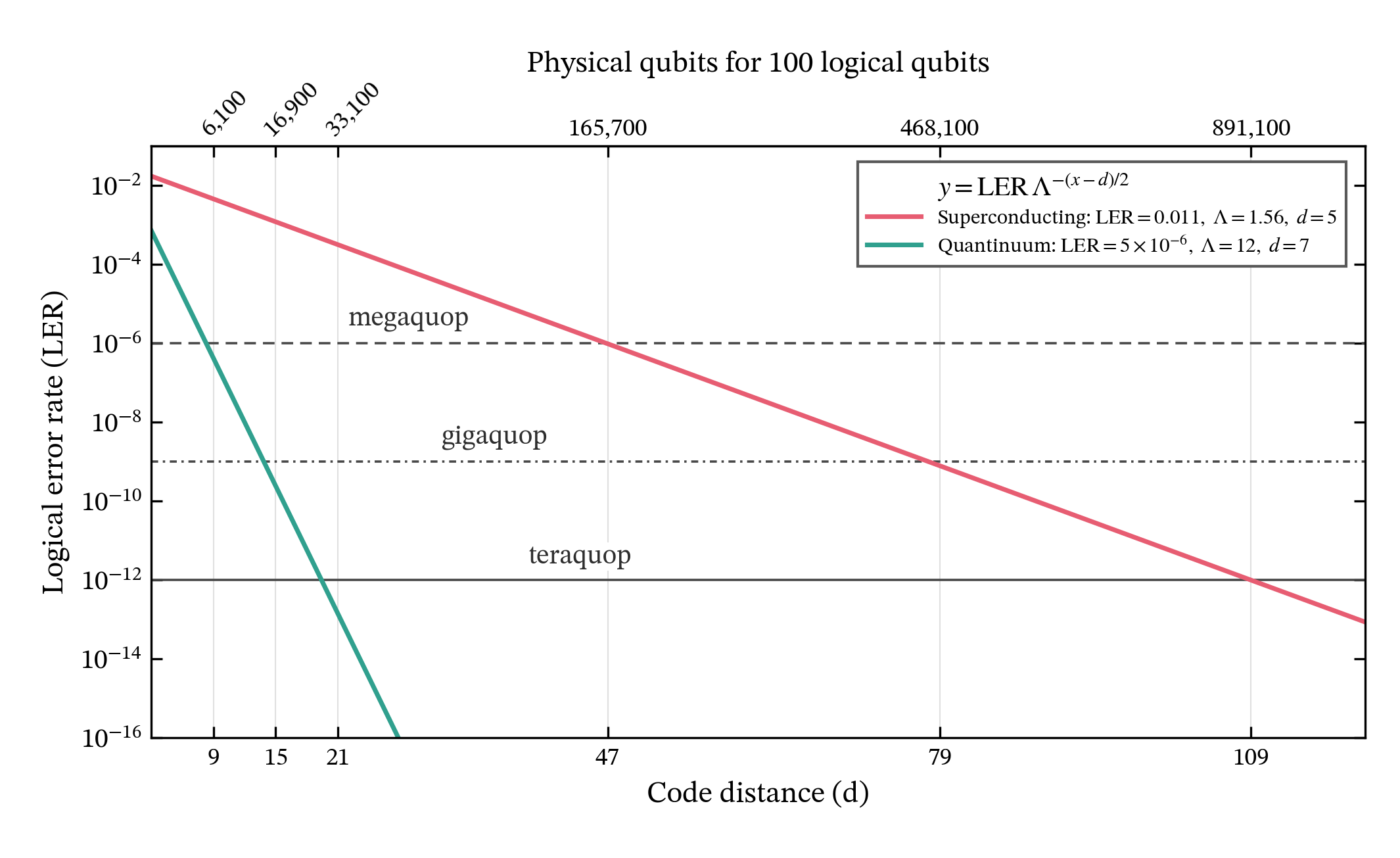
This all comes down to the value of Λ, which describes how quickly error rates decrease with increasing code distance. The most comparable result, , had a Λ of 1.56, while Helios demonstrated a Λ of 12. This means that we can hit a ‘utility scale’ error rate, say 10-12, with shorter distance codes - which translates to far less physical qubits.
Figure 5. Logical Error Rate scaling with color code distance. The green line indicates ³Ô¹ÏºÚÁÏÍø Helios’ projected logical error rate based on this work [LINK]. The pink line indicates a superconducting architecture’s projected logical error rate based on .
Mathematically, this is a straightforward calculation: you take a known error rate at a given distance (call this LERd), then you compute LERd×Âì(x-d)/2, then find whatever code distance is needed to get to your desired error rate. Â
The plot above compares state-of-the-art color code implementations on Helios and a superconducting architecture. For an error rate of 10-12, indicated with a horizontal black line, the superconducting system would need a code distance of 109 to achieve the target error rate, while our computers would only need a code distance of 219.
Translating this into a physical qubit requirement to generate 100 logical qubits, the superconducting processor would need ~900,000 physical qubits while our QCCD processors would only need ~30,000, a ~30x resource savings. This also brings in timelines: building a 30,000-qubit processor is much more likely in the near term than a 900,000-qubit processor.
In our recent blog about the Helix QEC architecture, we pointed out how our targeted physical fidelities will keep advancing our logical fidelities. That holds here as well: with the physical fidelity improvements targeted for Sol and Apollo, we will see an improved LERd and Λ, meaning that we can achieve target error rates at even shorter distance codes than above. This brings in timelines further: even fewer physical qubits will be needed.
Finally, we have access to codes that cost less qubits in the first place. These ‘high encoding rate’ codes require connectivity beyond what is available in fixed qubit superconducting systems. With our reconfigurable qubits, we can implement exotic entangling schemes that allow for a single physical qubit to be shared amongst several logical qubits, further improving resource estimates and bringing in the timelines to large scale utility. � Our Sol system, coming next year, will continue to reduce these costs by moving us to a grid-shaped trap, shortening transport and cooling times, while enabling full connectivity at a larger scale.
�
Figure 6. A qubit moves through a prototype grid trap, demonstrating the precise control and dynamic qubit transport that enable all-to-all connectivity in our QCCD architecture. This is footage from an operating device, not an artist’s rendering.
An important takeaway is that a lot of resource estimates that claim we will need X qubits or Y gates to do some algorithm are outdated; as they rely on assumptions about distance scaling and QEC codes that are not relevant to our QCCD architecture. With our high fidelity and full connectivity, we will be able to achieve target applications sooner than expected (compared to many external estimates), needing fewer qubits and fewer gates overall.
Helios as a pathfinder
�
Figure 7. Qubits are rearranged within a prototype grid trap using broadcast control signals, demonstrating our solution to quantum computing’s “wiring problem.� This approach dramatically reduces the number of control signals—or “wires�—needed to route qubits, overcoming a critical barrier to scaling into the megaquop regime. . The video shows real qubits in motion—it is not an artist’s rendering.
This result reflects more than the performance of an exceptional QPU. It is the product of a cross-functional, full-stack team working in close coordination, using Helios as a pathfinder for our next generation systems.
For example, one challenge every leading quantum computing platform faces is leakage: an unwanted process that takes the system out of the two qubit states used for computation. Leakage is especially damaging for QEC codes, which are built to fix errors within those two states and are not equipped to handle a qubit that has left them. Moreover, all subsequent operations on a leaked qubit quietly fail — a single leak can lead to a cascade of correlated errors which could result in a logical failure.
On Helios, the team built a mid-circuit fix: ‘leakage repump’, which returns leaked qubits back into the computational states as ordinary, correctable errors — improving our logical error rate by over an order of magnitude and enabling our distance-scaling demonstration.
Another example is ultra-efficient decoding. Syndrome data must be interpreted quickly enough to correct errors before the quantum information degrades. The team evaluated several approaches, including machine-learning decoders developed by ³Ô¹ÏºÚÁÏÍø’s AI team, ultimately demonstrating accurate decoding with sub-millisecond latency, which is 10-100x faster than needed to get corrections.
Both of these point to Helios operating in pathfinder mode: helping us understand how to extract the best performance from this generation of hardware, while translating those lessons into the next. That knowledge cannot come from simulation alone – we need to build and test real hardware to continue advancing. As Lead Physicist Dr. Adam Reed put it,  "When we push Helios to its limits, we often learn something the simulations didn't tell us."
By bringing together our theory, facilities, AI, and hardware teams, we pushed our trapped-ion hardware into a new performance regime—showing how our flexible logical architecture, tailored decoders, and highly accurate trapped-ion hardware work together to advance our path to Apollo in 2029.
Figure 8. Our roadmap.
1 Noisy Intermediate-Scale Quantum �
2 In practice, we ran for 580,000 shots (29k shots, each one having 20 rounds, and observed 3 failures), which gave us just enough statistical confidence to claim the ultimate error rate. �
3 As you can see in Figure 3, the suppression factor has error bars of +8 and -4, meaning it could be much better or closer to the 12x we measured in the other experiment. �
4 With the color code, only odd code distances are available. �
5 (with a maximum distance of 5) showed an error rate of 1.1% per cycle, in which case Helios shows a 2,200x improvement. �
6 If you want to compare these demonstrations at the same distance, Helios showed an error rate of 0.004% with a distance 5 code, which is a 204x improvement. �
7 (with a maximum distance of 7) showed an error rate of 0.143% per cycle, in which case Helios shows a 286x improvement. �
8 Quantum Charge Coupled Device �
9 It might look like we need a shorter distance code, but recall that only odd code distances are available with the color code. To hit the teraquop regime, we need slightly more than a code distance of 19. The next highest distance is 21.