ԹϺ

ԹϺ Overcomes Last Major Hurdle to Deliver Scalable Universal Fault-Tolerant Quantum Computers by 2029

In a landmark scientific breakthrough, ԹϺ becomes the first company to demonstrate a fully fault-tolerant universal gate set with repeatable error correction, and in doing so, achieved a ten-fold improvement over current industry-leading benchmarks

June 26, 2025

Quantum computing companies are poised to exceed $1 billion in revenues by the close of 2025, to McKinsey & Company, underscoring how today’s quantum computers are already delivering customer value in their current phase of development.

This figure is projected to reach upwards of $37 billion by 2030, rising in parallel with escalating demand, as well as with the scale of the machines and the complexity of problem sets of which they will be able to address.  

Several systems on the market today are fault-tolerant by design, meaning they are capable of suppressing error-causing noise to yield reliable calculations. However, the full potential of quantum computing to tackle problems of true industrial relevance, in areas like medicine, energy, and finance, remains contingent on an architecture that supports a fully fault-tolerant universal gate set with repeatable error correction—a capability that, until now, has eluded the industry.  

ԹϺ is the first—and only—company to achieve this critical technical breakthrough, universally recognized as the essential precursor to scalable, industrial-scale quantum computing. This milestone provides us with the most de-risked development roadmap in the industry and positions us to fulfill our promise to deliver our universal, fully fault-tolerant quantum computer, Apollo, by 2029.

In this regard, ԹϺ is the first company to step from the so-called “NISQ” (noisy intermediate-scale quantum) era towards utility-scale quantum computers.

Unpacking our achievement: first, a ‘full’ primer

A quantum computer uses operations called gates to process information in ways that even today’s fastest supercomputers cannot. The industry typically refers to two types of gates for quantum computers:

  • Clifford gates, which can be easily simulated by classical computers, and are relatively easy to implement; and
  • Non-Clifford gates, which are usually harder to implement, but are required to enable true quantum computation (when combined with their siblings).

A system that can run both gates is classified as and has the machinery to tackle the widest range of problems. Without non-Clifford gates, a quantum computer is non-universal and restricted to smaller, easier sets of tasks - and it can always be simulated by classical computers. This is like painting with a full palette of primary colors, versus only having one or two to work with. Simply put, a quantum computer that cannot implement ‘non-Clifford’ gates is not really a quantum computer.

A fault-tolerant, or error-corrected, quantum computer detects and corrects its own errors (or faults) to produce reliable results. ԹϺ has the best and brightest scientists dedicated to keeping our systems’ error rates the lowest in the world.

For a quantum computer to be fully fault-tolerant, every operation must be error-resilient, across Clifford gates and non-Clifford gates, and thus, performing “a full gate set” with error correction. While some groups have performed fully fault-tolerant gate sets in academic settings, these demonstrations were done with only a few qubits and —too high for any practical use.

Today, we have published that establishes ԹϺ as the first company to develop a complete solution for a universal fully fault-tolerant quantum computer with repeatable error correction, and error rates low enough for real-world applications.

This is where the magic happens

The describes how scientists at ԹϺ used our System Model H1-1 to perfect magic state production, a crucial technique for achieving a fully fault-tolerant universal gate set. In doing so, they set a record magic state infidelity (7x10⁻⁵), 10x better than any .

Our simulations show that our system could reach a magic state infidelity of 10^-10, or about one error per 10 billion operations, on a larger-scale computer with our current physical error rate. We anticipate reaching 10^-14, or about one error per 100 trillion operations, as we continue to advance our hardware. This means that our roadmap is now derisked.

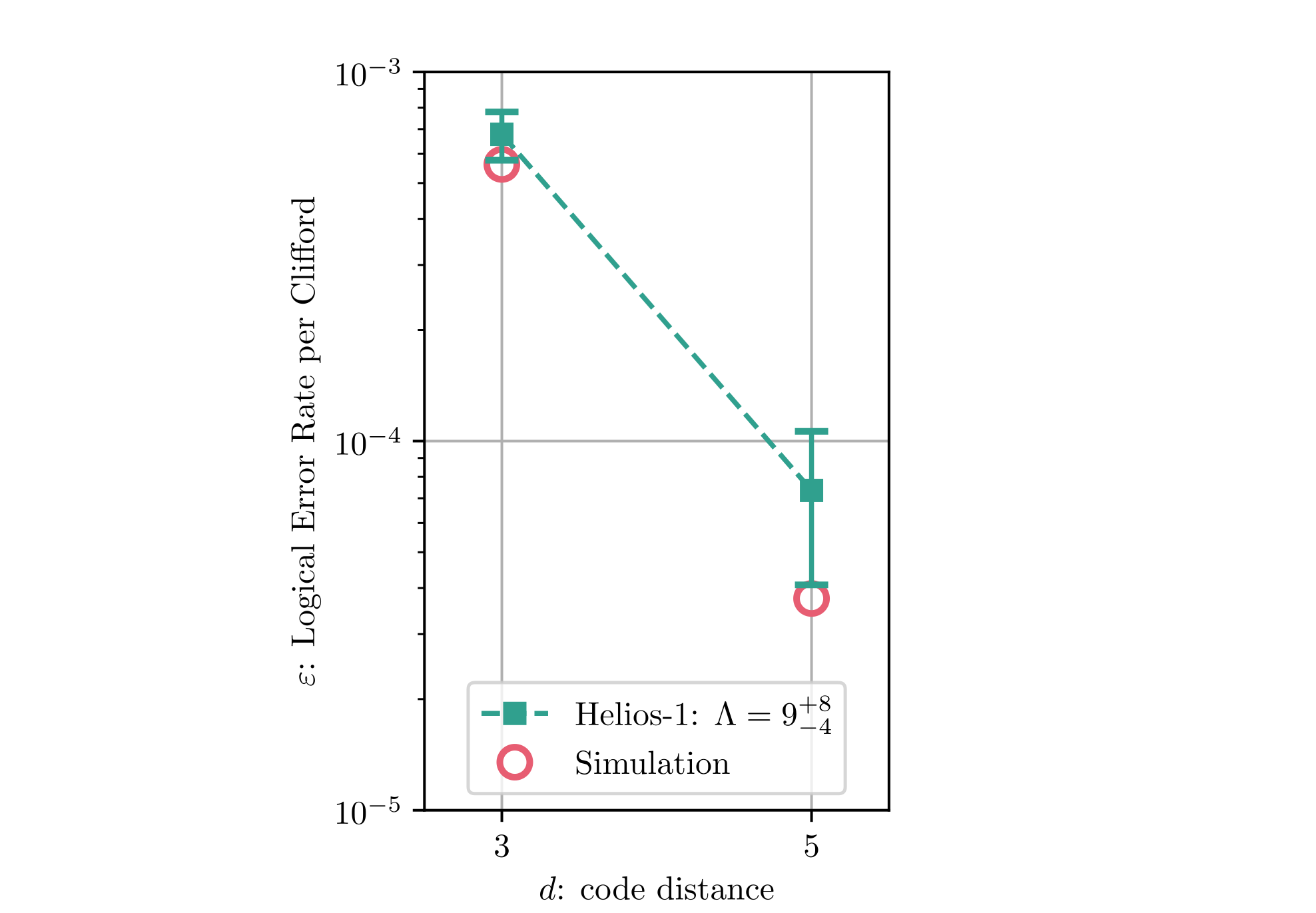
Setting a record magic state infidelity was just the beginning. The paper also presents the first break-even two-qubit non-Clifford gate, demonstrating a logical error rate below the physical one. In doing so, the team set another record for two-qubit non-Clifford gate infidelity (2x10⁻⁴, almost 10x better than our physical error rate). Putting everything together, the team ran the first circuit that used a fully fault-tolerant universal gate set, a critical moment for our industry.

Flipping the switch

In the , co-authored with researchers at the University of California at Davis, we demonstrated an important technique for universal fault-tolerance called “code switching”.

Code switching describes switching between different error correcting codes. The team then used the technique to demonstrate the key ingredients for universal computation, this time using a code where we’ve previously demonstrated full error correction and the other ingredients for universality.

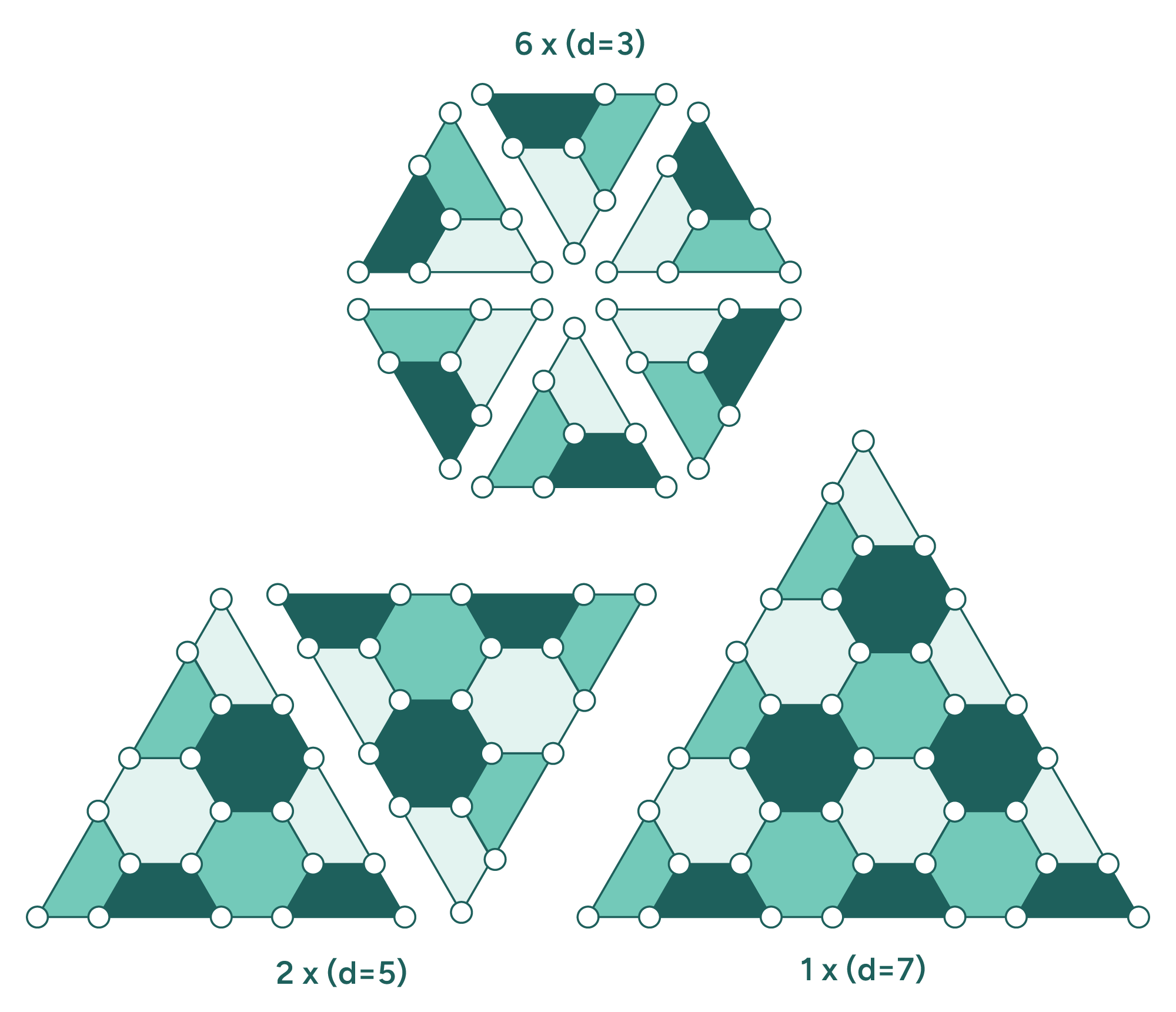
In the process, the team set a new record for magic states in a distance-3 error correcting code, over 10x better than with error correction. Notably, this process only cost 28 qubits . This completes, for the first time, the ingredient list for a universal gate setin a system that also has real-time and repeatable QEC.

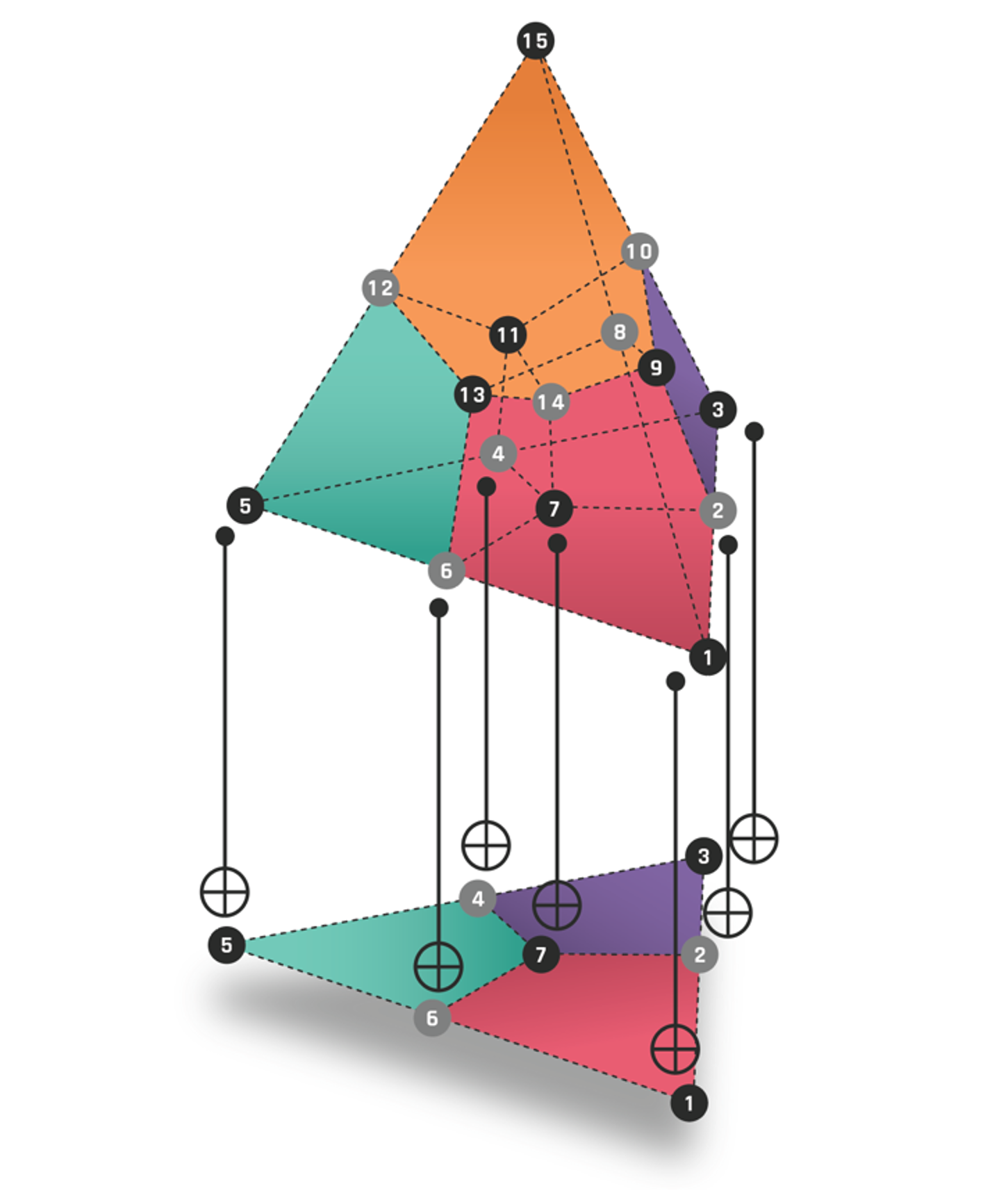
To perform "code switching", one can implement a logical gate between a 2D code and a 3D code, as pictured above. This type of advanced error correcting process requires ԹϺ's reconfigurable connectivity.
Fully equipped for fault-tolerance

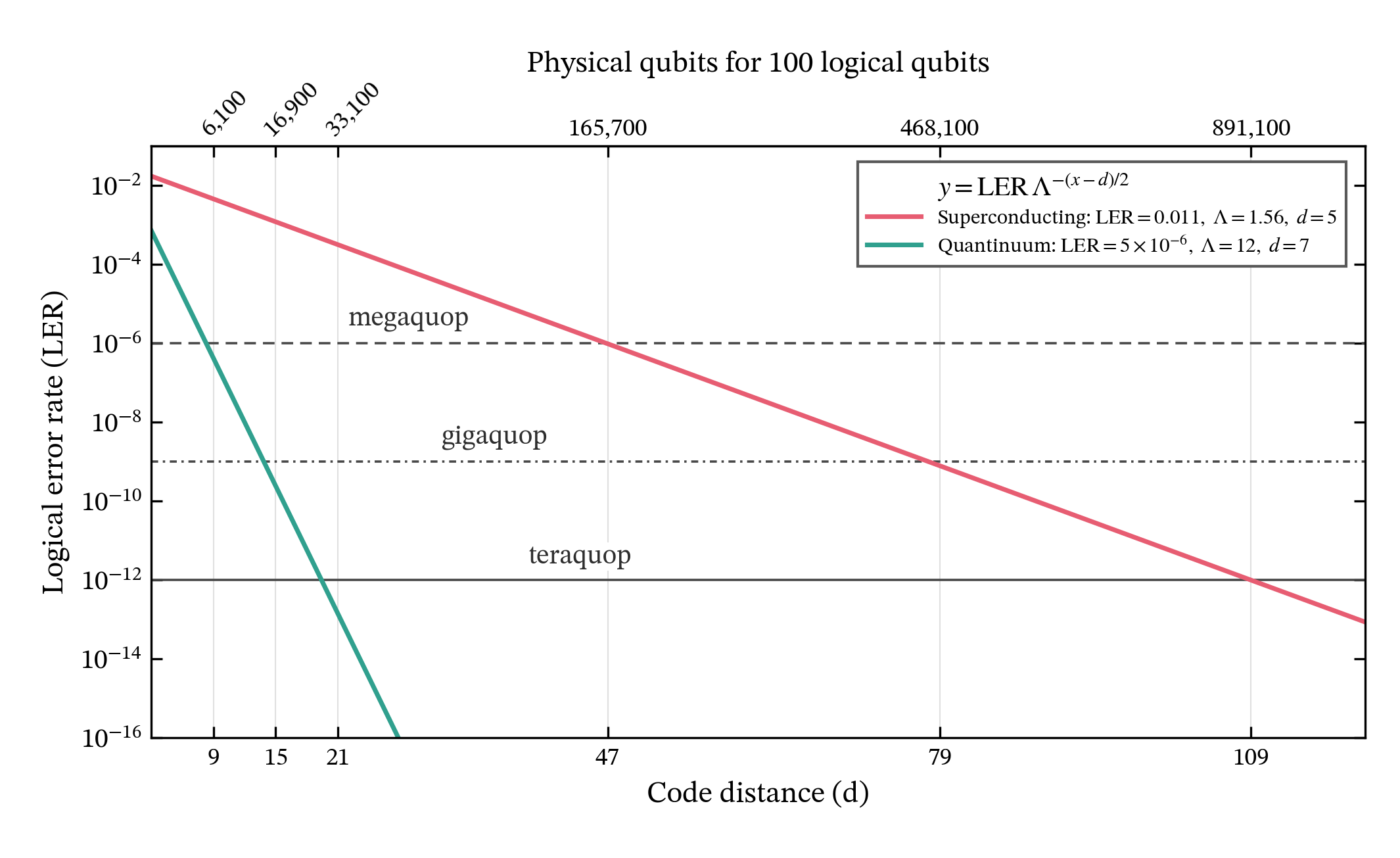
Innovations like those described in these two papers can reduce estimates for qubit requirements by an order of magnitude, or more, bringing powerful quantum applications within reach far sooner.

With all of the required pieces now, finally, in place, we are ‘fully’ equipped to become the first company to perform universal fully fault-tolerant computing—just in time for the arrival of Helios, our next generation system launching this year, and what is very likely to remain as the most powerful quantum computer on the market until the launch of its successor, Sol, arriving in 2027.

About ԹϺ

ԹϺ, the world’s largest integrated quantum company, pioneers powerful quantum computers and advanced software solutions. ԹϺ’s technology drives breakthroughs in materials discovery, cybersecurity, and next-gen quantum AI. With over 500 employees, including 370+ scientists and engineers, ԹϺ leads the quantum computing revolution across continents. 

Blog
|
technical
June 10, 2026
ԹϺ's Fault-Tolerance Advantage: Turning Quantum Reliability into Commercial Usefulness
  • ԹϺ continues its progress toward fault-tolerant quantum computing, with a series of peer-reviewed breakthroughs in fault-tolerant operations.
  • Our progress is not only scientific; it is commercial. By improving logical-qubit reliability and encoding efficiency, ԹϺ is reducing the resource overhead required to scale its quantum computers toward commercially useful workloads.
  • These results were achieved on commercial ԹϺ hardware, reinforcing that our architecture is not just setting new standards, but building a practical foundation for customers, partners, and researchers preparing for the fault-tolerant era.

Fault-tolerant quantum computing is the threshold the industry must cross before quantum computers can solve the hardest, highest-value problems with confidence. To be commercially useful at scale, the question is not simply who can build more qubits. It is who can build reliable, efficient, scalable systems that reduce technical risk and accelerate the path to commercial usefulness.

ԹϺ is progressing on that path.

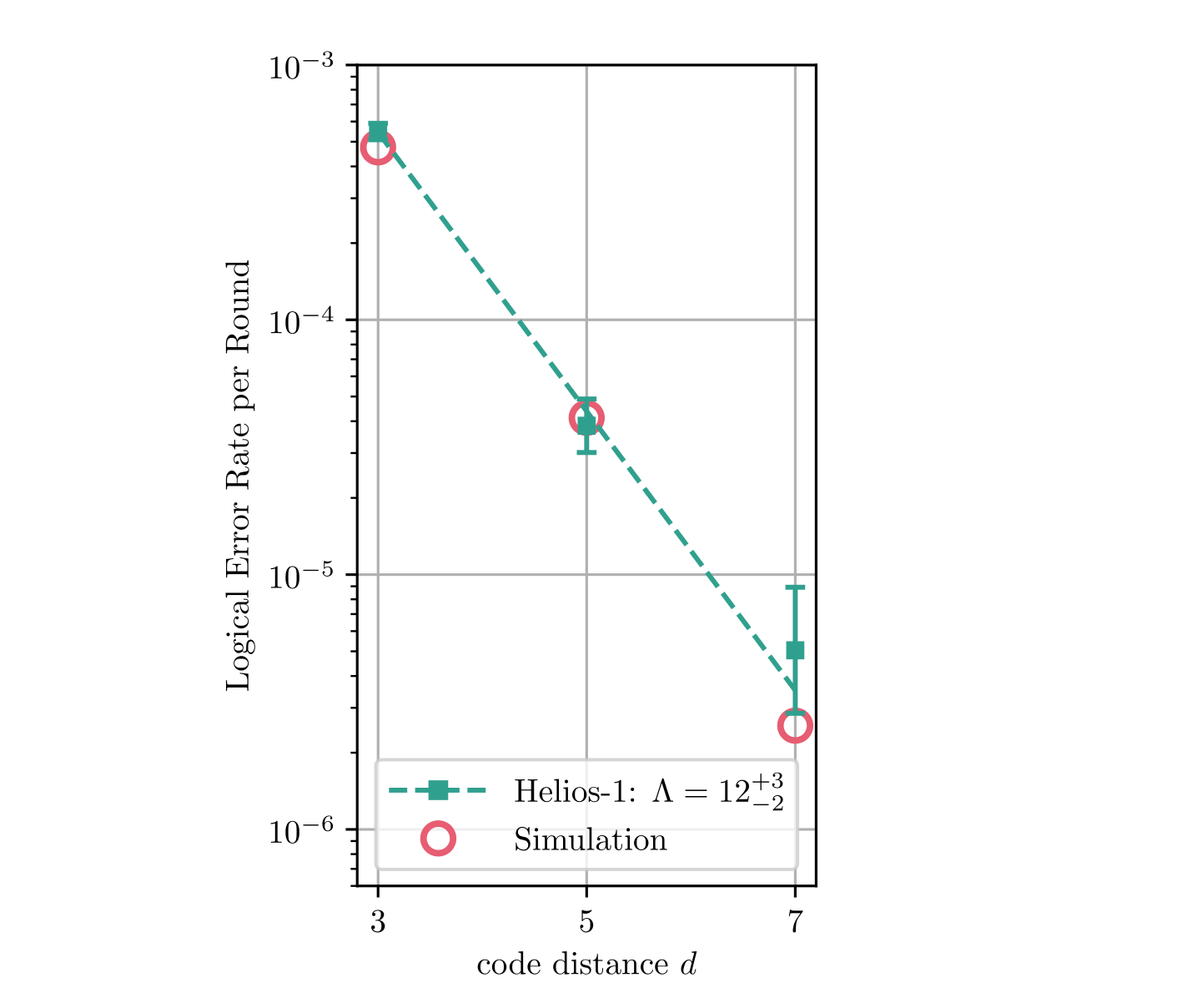
Last year, in partnership with Microsoft, we published a breakthrough in logical computing, demonstrating logical qubits that outperformed their physical counterparts by a factor of 800. We are proud to announce that this work is now being published in Nature, one of the most highly regarded scientific journals in the world.  

This work highlights our leading fidelities, as shown in Table 1:

Since then, we’ve accelerated our efforts to reach large-scale fault tolerance and advanced what we believe to be the core building blocks of fault-tolerant quantum computing, from logical-qubit teleportation and multiple error-correction breakthroughs to one of the first meaningful computations using logical qubits. Importantly, these results were achieved on commercial ԹϺ hardware, demonstrating not just scientific progress, but a practical and efficient path toward scalable, customer-ready fault tolerance.

A Recap of Our Recent Technical Progress

Since the work with Microsoft, we achieved a milestone years ahead of schedule, demonstrating high-fidelity teleportation of a logical qubit, which was published in one of the world’s most prestigious journals. Later, we beat our own record in this crucial fault tolerance milestone, thanks to continued improvements to our System Model H2’s fidelity.

Then, a series of results demonstrating more error-correcting milestones (and codes):

  • Better than physical results in a ,
  • (which significantly reduces resource requirements) in 4 dimensions
  • with a concatenated code
  • Observed with concatenated codes
  • High fidelity magic states and a fully fault tolerant universal gate set in two

Recently, we topped ourselves yet again by performing one of the first meaningful computations with logical qubits – exploring key questions in materials and magnetism, using . This result also includes a leading “encoding rate” squeezing 48 logical qubits out of just 98 physical qubits, emphasizing how our architecture helps to support large scale fault tolerance without enormous resource costs.

It is worth noting that all these results were achieved on our commercial hardware, not on one-off laboratory test-stands – reflecting the performance that we are able to deliver to our customers.

We also did crucial theoretical work, exploring that can reduce resource requirements, time to solution, and shorten the timeline to large scale fault tolerance.

Commercial Implications and the Road Ahead

We believe the commercial implication is clear: ԹϺ is reducing the uncertainty around the path to fault-tolerant quantum computing. Our architecture, hardware fidelity, full-stack control, and error-correction progress are converging into a practical roadmap for systems that can support valuable scientific and commercial workloads.

For those evaluating when quantum computing will become strategically relevant, we believe the signal is also increasingly clear: the fault-tolerant era is no longer a distant concept. It is becoming an engineering reality, and ԹϺ is leading the way.

technical
All
Blog
|
partnership
May 7, 2026
Denmark Strengthens its Quantum Leadership with ԹϺ Helios
  • University of Southern Denmark (SDU) to use ԹϺ Helios, supported by the Danish e-Infrastructure Consortium (DeiC)
  • Access to Helios enables SDU to test and refine fault-tolerant algorithms and error-correction codes under realistic hardware conditions
  • The collaboration supports at a scale of 48 logical qubits, positioning Denmark at the forefront of scalable, practical quantum computing
  • Researchers exploring the scientific foundations for future development of applications in fields including pharmaceuticals, finance, and defense

Progress in quantum computing is measured by hardware advances plus the algorithms and quantum error-correction codes that turn quantum systems into useful computational tools.

Thanks to recent hardware advances, researchers are increasingly sharpening their tools to probe the performance of quantum algorithms and understand how they behave in realistic conditions – where stability, system architecture and algorithm design all shape performance.

A new Denmark-based collaboration between the University of Southern Denmark (SDU), ԹϺ, and the Danish e-Infrastructure Consortium (DeiC) will utilize ԹϺ Helios. Researchers at the SDU’s Centre for Quantum Mathematics, led by Jørgen Ellegaard Andersen, will use Helios to pursue research into topological quantum computing.

Their work could help explain how and why successful quantum algorithms perform as they do, informing the development of high-performance algorithms suited to emerging quantum systems. They’re exploring the scientific foundations that support future quantum applications across areas including pharmaceuticals, finance, and defense.

“We are thrilled to gain access to ԹϺ’s high-fidelity Helios system. This collaboration gives us a unique opportunity to test the limits of our algorithms and evaluate system performance, while advancing fundamental research and laying the foundation for future applications.”

— Professor Jørgen Ellegaard Andersen, Director of the Centre for Quantum Mathematics at University of Southern Denmark
Why topological methods matter

Topological quantum computing is an area of research that connects quantum computation with deep mathematical structures. It includes the study of error correcting codes known as surface codes that encode quantum information in the global properties of systems of logical qubits.

The research team will explore how these codes behave, and how they may support the development of fault-tolerant quantum algorithms in practical implementations under realistic conditions.

This distinction between theory and practical implementation matters. In theory, topological approaches offer a rich framework for designing algorithms and error-correcting codes. In practice, researchers need to understand how those ideas perform when implemented on real systems, where questions of noise, stability, overhead, and scaling become central. The collaboration will allow the SDU team to investigate these questions directly.

New ways to benchmark quantum processors

Beyond individual algorithms and codes, the research will also develop tools for benchmarking quantum processors. The goal is to develop new ways to characterize fidelity and stability in regimes that can be difficult to access.

The team will also explore hybrid quantum–classical approaches, including machine-learning techniques assisted by quantum hardware, to study the mathematical structures at the heart of topological quantum computing. This work reflects a broader field of research in which quantum and classical methods are used together, each contributing to parts of a computational problem.

Strengthening Denmark’s quantum ecosystem

The collaboration reflects the growing role of national quantum infrastructure in supporting research and talent development. Denmark has a long tradition of scientific innovation, and this collaboration is intended to support the country’s continued development in quantum technology.

The initiative is supported by DeiC, which played a central role in securing funding and enabling access to ԹϺ’s systems. DeiC has been assigned a particular role in developing and coordinating quantum infrastructure initiatives for the benefit of universities and industry, operating without its own commercial, sectoral, or geographical interests. This includes securing dedicated access to quantum computers, producing advisory services and supporting the development of new talent in the Danish quantum sector.

“DeiC’s special effort to secure funding and access for this research initiative is rooted in our organization’s role in relation to the Danish Government’s strategy for quantum technology.”

— Henrik Navntoft Sønderskov, Head of Quantum at Danish e-Infrastructure Consortium

This collaboration promises to accelerate the development of practical algorithms. It is grounded in fundamental science – but its focus is practical: discovering and testing mathematical approaches to topological quantum computing that can be implemented, evaluated, and improved on real quantum hardware.

That work requires both theoretical insight and access to a system such as Helios capable of supporting meaningful scientific work.

partnership
All
Blog
|
corporate
March 25, 2026
Celebrating Our First Annual Q-Net Connect!

This month, ԹϺ welcomed its global user community to the first-ever Q-Net Connect, an annual forum designed to spark collaboration, share insights, and accelerate innovation across our full-stack quantum computing platforms. Over two days, users came together not only to learn from one another, but to build the relationships and momentum that we believe will help define the next chapter of quantum computing.

Q-Net Connect 2026 drew over 170 attendees from around the world to Denver, Colorado, including representatives from commercial enterprises and startups, academia and research institutions, and the public sector and non-profits - all users of ԹϺ systems.  

The program was packed with inspiring keynotes, technical tracks, and customer presentations. Attendees heard from leaders at ԹϺ, as well as our partners at NVIDIA, JPMorganChase and BlueQubit; professors from the University of New Mexico, the University of Nottingham and Harvard University; national labs, including NIST, Oak Ridge National Laboratory, Sandia National Laboratories and Los Alamos National Laboratory; and other distinguished guests from across the global quantum ecosystem.

Congratulations to Q-Net Connect 2026 Award Recipients! 

The mission of the ԹϺ Q-Net user community is to create a space for shared learning, collaboration and connection for those who adopt ԹϺ’s hardware, software and middleware platform. At this year’s Q-Net Connect, we awarded four organizations who made notable efforts to champion this effort. 

  • JPMorganChase received the ‘Guppy Adopter Award’ for their exemplary adoption of our quantum programming language, Guppy, in their research workflows. 
  • Phasecraft, a UK and US-based quantum algorithms startup, received the ‘Rising Star’ award for demonstrating exceptional early impact and advancing science using ԹϺ hardware, which they published in a December 2025 .
  • Qedma, a quantum software startup, received the ‘Startup Partner Engagement’ award for their sustained engagement with ԹϺ platforms dating back to our first commercially deployed quantum computer, H1.
  • Anna Dalmasso from the University of Nottingham received our ‘New Student Award’ for her impressive debut project on ԹϺ hardware and for delivering outstanding results as a new Q-Net student user. 

Congratulations, again, and thank you to everyone who contributed to the success of the first Q-Net Connect!

Become a Q-Net Member

Q-Net offers year‑round support through user access, developer tools, documentation, trainings, webinars, and events. Members enjoy many exclusive benefits, including being the first to hear about exclusive content, publications and promotional offers.

By joining the community, you will be invited to exclusive gatherings to hear about the latest breakthroughs and connect with industry experts driving quantum innovation. Members also get access to Q‑Net Connect recordings and stay connected for future community updates.

corporate
All
events
All